
Hosted by site sponsor WebMate.
MacBook Air Q&A
Revision Published July 13, 2008
All Mac Q&As >> MacBook Air Q&A (Home) | Also See: All MacBook Air Specs
To be notified of new Q&As, sign up for EveryMac.com's bimonthly email list.
How does the original MacBook Air compare to the PowerBook G4 12-Inch models?
Please note that all models mentioned in this Q&A have been discontinued. However, it has been updated subsequently and is quite useful for anyone buying or selling one of these models on the used market or just for "historical" reference.
Although the last one was discontinued May 16, 2006, the PowerBook G4 12-Inch models were the smallest notebooks Apple offered prior to the release of the original MacBook Air on January 15, 2008.
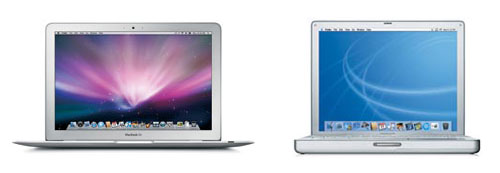
Photo Credit: Apple, Inc. (MacBook Air - Left, PowerBook G4 12" - Right, Not to Scale)
The PowerBook G4 12-Inch models were relatively small, but the compromises Apple made to release a system with such a form factor were far more modest than those made for the much, much thinner MacBook Air.
There were a number of PowerBook G4 12-Inch models released with varying capabilities. The last PowerBook G4 12-Inch model -- the PowerBook G4/1.5 12" (Al) -- for example, when compared to the 15-Inch and 17-Inch PowerBook G4 models available at the time had a smaller display (as one would expect), a slightly slower processor, slower memory, lower maximum memory capacity, slower graphics with less video memory, a less capable optical drive, and fewer connectivity options -- the loss of a PC card slot, a Firewire "800" port (it still had a Firewire "400" port), and Gigabit Ethernet.
When compared to the "consumer" level 12-Inch iBook model available at the time -- the iBook G4/1.33 12-Inch -- however, the PowerBook G4 12-Inch still was differentiated by a higher-quality and slightly smaller case, a better keyboard, a faster processor and system bus, superior graphics (and formal external display support), and sound in.
In other words, the PowerBook G4 12-Inch was clearly differentiated from the lower-end "consumer" models and the trade-offs between it and the other "professional" models were modest -- generally just reducing capability rather than eliminating it.
For the MacBook Air, however, when compared to "consumer" MacBook systems, it has some advantages -- in particular, it's small and beautiful -- and some disadvantages -- in performance, expansion, and connectivity. Apple has eliminated -- rather than merely reduced -- some capability to produce a true subnotebook that still has a full-size keyboard and a relatively large 13.3-inch display.
The market will determine whether or not eliminating some functionality to release a sub-three pound 13.3-inch notebook was wise. No doubt some love it and others would rather have a four pound notebook with present day performance and connectivity more comparable to the PowerBook G4.
Comparison Chart
To directly compare the MacBook Air "Core 2 Duo" 1.6 13" to the final PowerBook G4/1.5 12", you may find this chart interesting:
| MacBook Air 1.6 13" | PowerBook G4 1.5/12" | |
|---|---|---|
| Release Date: | January 15, 2008 | January 31, 2005 |
| Processor Type: | Intel Core 2 Duo | PowerPC 7447a (G4) |
| Processor Speeds: | 1.6-1.8 GHz | 1.5 GHz |
| Video System: | Intel GMA X3100 | NVIDIA GeForce FX Go5200 |
| Video Type: | Integrated | Dedicated |
| Video Memory: | 144 MB* | 64 MB |
| Display Size: | 13.3" | 12.1" |
| Backlighting: | LED | CCFL |
| Native Resolution: | 1280x800 | 1024x768 |
| Ext. Display: | 1920x1200 | 2048x1536 |
| Hard Drive Size: | 80 GB† | 60, 80 GB† |
| Hard Drive Type: | PATA (ZIF) | Ultra ATA/100 |
| Default Memory: | 2 GB | 512 MB |
| Max Memory: | 2 GB | 1.25 GB |
| USB 2.0: | Yes (1) | Yes (2) |
| Firewire 400: | No | Yes (1) |
| Ambient KB: | Yes | No |
| Multitouch Trackpad: | Yes | No |
| SuperDrive: | Optional (External) | Standard†† (Internal) |
| Swappable Battery: | No | Yes |
| Case Color: | Silver | Silver |
| Size (Inches): | .16-.76 x 12.8 x 8.94 | 1.18 x 10.9 x 8.6 |
| Weight: | 3.0 lbs (1.36 kg) | 4.6 lbs (2.1 kg) |
| Max Battery Life: | 5 Hours§ | 5 Hours§ |
| Intro Price Range: | US$1799-US$3098 | US$1499-US$1699 |
* The MacBook Air "borrows" main memory for video function. Minimum graphics memory usage is 144 MB.
† For the MacBook Air, a 64 GB SSD version originally was available as a US$999 upgrade, or configured along with a 1.8 GHz processor for US$3098 total. On July 8, 2008, Apple dropped the price to US$599 for the SSD upgrade alone or US$2598 for the upgraded system. The PowerBook G4 1.5 12" also could be configured with a 100 GB hard drive as a build-to-order option.
†† One configuration had a less capable "Combo" drive. Please refer to the specs page for complete details.
§ Maximum battery life as reported by the manufacturer.
Comparison Summary
Ultimately, if you stuck with a PowerBook G4 12-Inch model and were hoping that Apple would release a more direct descendent as a MacBook Pro model, it is probably wise to not hold your breath. Instead, you will have to decide whether it makes more sense to buy a comparably equipped "regular" MacBook -- but with a modest increase in size compared to the PowerBook G4 12-Inch -- or whether the trade-offs in performance, connectivity, and expansion are worthwhile sacrifices to make for the extremely sleek and lightweight MacBook Air.
In the US, site sponsor Other World Computing sells used and refurb MacBook Air models at bargain prices with free shipping, as well. On the other hand, if you need to sell a MacBook Air, A+ BBB-rated Cash for Your Mac and GoRoostr will buy your older notebook with an instant quote and prompt payment.
In the UK, site sponsor Hoxton Macs sells used MacBook Air models with a one-year warranty and free next day delivery throughout the UK. Delivery across Europe also is available starting at just £9.99 for two-day delivery to France and Germany.
Please refer to EveryMac.com's Ultimate Mac Comparison feature to dynamically compare any MacBook Air model to any other G3 or later Mac.
Permalink | Report an Error/Typo | Sign Up for Site Update Notices
Established in 1996, EveryMac.com has been created by experts with decades of experience with Apple hardware. EveryMac.com includes, and always has included, original research incorporating detailed, hands-on inspection of packaging, computers, and devices as well as extensive real-world use. All information is provided in good faith, but no website or person is perfect. Accordingly, EveryMac.com is provided "as is" without warranty of any kind whatsoever. EveryMac.com, and the authors thereof, shall not be held responsible or liable, under any circumstances, for any damages resulting from the use or inability to use the information within. For complete disclaimer and copyright information please read and understand the Terms of Use and the Privacy Policy before using EveryMac.com. Copying, scraping, or use of any content without expressed permission is not allowed, although links to any page are welcomed and appreciated.