
Hosted by site sponsor WebMate.
MacBook Air Q&A
Published November 9, 2010
All Mac Q&As >> MacBook Air Q&A (Home) | Also See: All MacBook Air Specs
To be notified of new Q&As, sign up for EveryMac.com's bimonthly email list.
How fast are the "Late 2010" MacBook Air models compared to one another and to earlier MacBook Air models? How fast are these models compared to the "Mid-2010" MacBook and MacBook Pro models?
Please note that all systems mentioned in this Q&A have been discontinued. However, this Q&A is up-to-date and quite helpful for anyone buying or selling one of these notebooks on the used market.
Just like all previous MacBook Air notebooks, the "Late 2010" MacBook Air models -- the MacBook Air "Core 2 Duo" 1.4 11-Inch and "Core 2 Duo" 1.86 13-Inch -- are designed for those who place more importance on size and weight than performance.
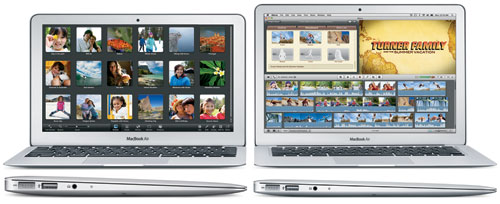
Photo Credit: Apple, Inc. (Left - 11" MacBook Air, Right - 13" MacBook Air)
Given this focus, it is not surprising that Apple has declined to published official benchmarks comparing the overall performance of the "Late 2010" MacBook Air models to other Mac notebooks. However, the company has placed some emphasis on the improved graphics performance compared to the "Mid-2009" MacBook Air models replaced.
For example, Apple touts that the NVIDIA GeForce 320M graphics processor in the "Late 2010" models delivers performance that is "over 2x faster" in Portal and Call of Duty 4 tests compared to the NVIDIA GeForce 9400M-equipped "Mid-2009" MacBook Air models. Nevertheless, both graphics processors share memory with the system and neither is particularly high-performance.
Third-Party Performance Tests
Given the significant internal differences between the "Late 2010" MacBook Air models and the "Mid-2009" MacBook Air models replaced as well as the internal differences between the "Mid-2010" MacBook and MacBook Pro models, only an assortment of benchmarks and real-world tests can adequately demonstrate the overall performance difference between these models in a variety of tasks.
In Speedbench 6.5 benchmark tests for the stock "Late 2010" MacBook Air models, MacWorld reported:
Looking at the performance differences between the new 13-inch 1.86 GHz MacBook Air and the 2009 13-inch 1.86 GHz MacBook Air, we see that the Speedmark 6.5 score actually doubled from 54 to 108. A lot of the gains were in drive tests, where the flash storage in the new MacBook Air took just 13 seconds to duplicate a 1 GB file compared to the older Air's sluggish 4200-rpm hard drive that took more than five times longer, a painful 69 seconds. . . and with the faster graphics and speedy flash storage, the 11-inch model was 35 percent faster overall than that 2009 2.13 GHz MacBook Air. . .
Comparing the 11-inch 1.4 GHz MacBook Air to the new 13-inch 1.86 GHz MacBook Air, we see the 13-inch system was about 27 percent faster in overall Speedmark 6.5 performance. . .
The 13-inch 1.86 GHz Core 2 Duo MacBook Air earned a Speedmark score that's just two points higher than the 13-inch 2.4 GHz MacBook Pro. The 13-inch 2.4 GHz MacBook Pro was 25 percent faster overall than the 11-inch 1.4 GHz Core 2 Duo MacBook Air. . . [However], the 15-inch 2.4 GHz Core i5 MacBook Pro's Speedmark 6.5 score is 55 percent higher than the 11-inch MacBook Air, and 22 percent higher than the 13-inch MacBook Air.
MacWorld also tested the custom-configured BTO "Late 2010" MacBook Air models -- with faster 1.6 GHz and 2.13 GHz processors -- for the 11-Inch and 13-Inch, respectively, as well as 4 GB of RAM in each. For these configurations, MacWorld found that:
Speedmark 6.5 results show the BTO 11-inch MacBook Air topping its standard configuration version by 12 percent, overall. . . The 13-inch MacBook Air BTO configuration was 10 percent faster than its stock configuration.
BareFeats likewise hit both the 11-Inch and 13-Inch MacBook Air with a number of benchmark and real-world CPU and graphics tests, concluding that "the MacBook Air can't compete with the 15-Inch MacBook Pro in terms of CPU power, [but] it does hold its own against the 13-Inch MacBook Pro." BareFeats also provides test results and a well-reasoned explanation of why the the "Late 2010" MacBook Air models are faster than their predecessors despite often slower clockspeeds.
ArsTechnica only tested the 11-Inch model, but put it through its paces in Geekbench, Cinebench and Xbench benchmark tests and declared the Xbench results to be the most interesting:
The 11" MacBook Air manages a mediocre 123 points composite score, but the 13" only tops that score by 20 percent. The 15" MacBook Pro only turns in a 30 percent better score, despite having about double the raw CPU power. Taking one look at the disk test reveals exactly what an equalizer the newly designed SSD modules are for the new Air models. The 11" MacBook Air had about three times the performance of the SSD in last year's 13" MacBook Air, and close to five times the performance of the spinning platter in the 15" MacBook Pro.
RegHardware, in turn, only tested the 13-Inch model, but did so running Windows. The site used the PCMark Vantage benchmark and the 13-Inch model scored 5279. By comparison, a MacBook Pro "Core i5" 2.53 17-Inch (Mid-2010) scored 6262.
For the most in-depth performance results for both the 11-Inch and 13-Inch models, there is no better source than AnandTech, which hit each with a barrage of tests covering everything from general OS performance, Photoshop, Aperture 2, and more. AnandTech also evaluated the BTO configurations with faster processors and more RAM and concluded:
On average the upgraded system was 15% faster than the base 11-inch MacBook Air. The base 13-inch MBA averaged around 19% faster across the board, however in application/usage models with large memory footprints the faster CPU had effectively no benefit.
Video Test Results
You may additionally find this "stress test" video of the 11-Inch MacBook Air from DetroitBORG to be useful as well for an idea of its "real-world" performance in actual use. Note that it starts to "stutter" when placed under considerably heavy load:
Performance Summary
Ultimately, the "Late 2010" MacBook Air models are designed to be sleek, small and lightweight rather than fast. However, despite modest internal specs -- and a mediocre 2 GB of RAM in the stock configurations -- the relatively speedy flash memory for storage makes a significant impact on overall performance. The build-to-order RAM and processor upgrades make a notable difference as well. For those with modest performance needs and reasonable expectations, the "Late 2010" MacBook Air models can work quite beautifully.
In the US, site sponsor Other World Computing sells used and refurb MacBook Air models at bargain prices with free shipping, as well. On the other hand, if you need to sell a MacBook Air, A+ BBB-rated Cash for Your Mac and GoRoostr will buy your older notebook with an instant quote and prompt payment.
In the UK, site sponsor Hoxton Macs sells used MacBook Air models with a one-year warranty and free next day delivery throughout the UK. Delivery across Europe also is available starting at just £9.99 for two-day delivery to France and Germany.
Permalink | Report an Error/Typo | Sign Up for Site Update Notices
Established in 1996, EveryMac.com has been created by experts with decades of experience with Apple hardware. EveryMac.com includes, and always has included, original research incorporating detailed, hands-on inspection of packaging, computers, and devices as well as extensive real-world use. All information is provided in good faith, but no website or person is perfect. Accordingly, EveryMac.com is provided "as is" without warranty of any kind whatsoever. EveryMac.com, and the authors thereof, shall not be held responsible or liable, under any circumstances, for any damages resulting from the use or inability to use the information within. For complete disclaimer and copyright information please read and understand the Terms of Use and the Privacy Policy before using EveryMac.com. Copying, scraping, or use of any content without expressed permission is not allowed, although links to any page are welcomed and appreciated.