
Hosted by site sponsor WebMate.
Unibody MacBook Pro Q&A
Update Published August 27, 2009
All Mac Q&As >> Unibody MacBook Pro Q&A | Also See: All MacBook Pro Specs
To be notified of new Q&As, sign up for EveryMac.com's bimonthly email list.
What are the differences between the "Mid-2009" 13-Inch, 15-Inch, and 17-Inch MacBook Pro Core 2 Duo models?
Please note that all MacBook Pro models mentioned in this Q&A have been discontinued. However, this Q&A is up-to-date and quite useful for anyone considering one of these notebooks on the used market.
If one only takes a quick glance at the "Mid-2009" 13-Inch, 15-Inch, and 17-Inch MacBook Pro models one would be unlikely to notice major differences apart from the obvious differences in physical dimensions and weight.
Naturally, the 13-Inch models -- the MacBook Pro "Core 2 Duo" 2.26 13" (SD/FW) and "Core 2 Duo" 2.53 13" (SD/FW) -- are smaller and lighter than the 15-Inch -- MacBook Pro "Core 2 Duo" 2.53 15" (SD), "Core 2 Duo" 2.66 15" (SD), and "Core 2 Duo" 2.8 15" (SD) -- which in turn are smaller and lighter than the 17-Inch MacBook Pro "Core 2 Duo" 2.8 17" (Mid-2009).
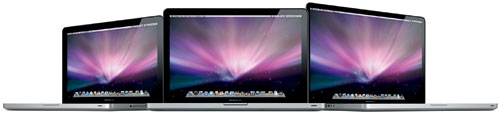
Photo Credit: Apple, Inc.
All of these models have a black and silver "Unibody" case -- milled from a single block of aluminum -- and all include backlit keyboards, a "no button" glass "multi-touch" trackpad with support for "four finger" gestures and programmable "zones", and have LED-backlit displays. By default, each has a "glossy" display, but the 15-Inch and 17-Inch models also are offered with an "anti-glare" configuration (with a silver "frame") for an additional US$50††.
All have a built-in non-swappable battery design -- like the previously introduced and subsequently discontinued MacBook Pro "Core 2 Duo" 2.66 17-Inch (Unibody) -- and this battery is not designed to be removed or serviced by end users. This may continue to be an issue for some -- those who value swapping out batteries on a long flight, for example -- but Apple reports that this design allows the company to increase battery life and the 13-Inch and 15-Inch models are estimated to provide 7 hours of runtime and the 17-Inch 8 hours of runtime in "wireless productivity" tests, so it may not be a major issue for others.
Connectivity between the 13-Inch, 15-Inch, and 17-Inch systems is a major point of product differentiation. All of these models include AirPort Extreme (802.11a/b/g/n), Bluetooth 2.1+EDR, Gigabit Ethernet, a single Firewire "800" port (yes, even the 13-Inch models), and a "Mini DisplayPort" that supports an external display at 2560x1600.
However, the 15-Inch and 17-Inch models have optical digital/analog audio in/out and the 13-Inch does not -- it lacks optical audio in and instead packs the same "combined optical digital output/headphone out (user-selectable analog audio line in)" port used by the iPhone. The 13-Inch and 15-Inch models have an SD card slot, whereas the 17-Inch has an ExpressCard/34 expansion slot instead. The 17-Inch model also has three USB 2.0 ports and the 13-Inch and 15-Inch models only have two.
Internally, the "Mid-2009" models are quite similar, actually. All use similar logic board designs and 45 nm "Penryn" Intel "Core 2 Duo" processors with two independent processor "cores" on a single silicon chip and a shared "on chip" level 2 cache (3 MB for the majority of the line and 6 MB for the high-end MacBook Pro "Core 2 Duo" 2.8 15" (SD) and MacBook Pro "Core 2 Duo" 2.8 17" (Mid-2009). All have a 1066 MHz frontside bus, support 8 GB of 1066 MHz DDR3 SDRAM (PC3-8500), support Serial ATA hard drives, and have an 8X DL "SuperDrive".
The major internal difference, however, is a substantial one. The 13-Inch MacBook Pro and low-end 15-Inch MacBook Pro -- the MacBook Pro "Core 2 Duo" 2.53 15" (SD) -- have a NVIDIA GeForce 9400M "graphics processor with 256 MB of DDR3 SDRAM shared with main memory", whereas the higher-end models -- the MacBook Pro "Core 2 Duo" 2.66 15" (SD), "Core 2 Duo" 2.8 15" (SD) and "Core 2 Duo" 2.8 17" (Mid-2009) have dual graphics processors -- a NVIDIA GeForce 9600M GT with dedicated GDDR3 SDRAM and the "integrated graphics" NVIDIA GeForce 9400M. The dedicated graphics processor is considerably higher performance than the integrated one but uses more battery power to operate so having both provides the "best of both worlds".
The major differences between the 13-Inch, 15-Inch, and 17-Inch "Mid-2009" MacBook Pro models -- size, display, battery life, connectivity, graphics, configuration, and price -- are summarized below:
| 2.26 13" | 2.53 13" | 2.53 15" | 2.66 15" | 2.8 15" | 2.8 17" | |
|---|---|---|---|---|---|---|
| Processor: | P8400 | P8700 | P8700 | P8800 | T9600* | T9600* |
| Speed: | 2.26 GHz | 2.53 GHz | 2.53 GHz | 2.66 GHz | 2.8 GHz* | 2.8 GHz* |
| L2 Cache: | 3 MB | 3 MB | 3 MB | 3 MB | 6 MB | 6 MB |
| Drive: | 160 GB | 250 GB | 250 GB | 320 GB | 500 GB | 500 GB |
| Std RAM: | 2 GB | 4 GB | 4 GB | 4 GB | 4 GB | 4 GB |
| GDDR3: | No | No | No | 256 MB** | 512 MB** | 512 MB** |
| USB 2.0: | 2 | 2 | 2 | 2 | 2 | 3 |
| FW 800: | 1 | 1 | 1 | 1 | 1 | 1 |
| Opt Audio: | No† | No† | Yes | Yes | Yes | Yes |
| SD Slot: | Yes | Yes | Yes | Yes | Yes | No |
| ExpCd/34: | No | No | No | No | No | Yes |
| Disp Size: | 13.3" | 13.3" | 15.4" | 15.4" | 15.4" | 17.0" |
| Matte Opt: | No | No | Yes†† | Yes†† | Yes†† | Yes†† |
| Resolution: | 1280x800 | 1280x800 | 1440x900 | 1440x900 | 1440x900 | 1920x1200 |
| Batt Life: | 7 Hours | 7 Hours | 7 Hours | 7 Hours | 7 Hours | 8 Hours |
| Height§: | 0.95 | 0.95 | 0.95 | 0.95 | 0.95 | 0.98 |
| Width§: | 12.78 | 12.78 | 14.35 | 14.35 | 14.35 | 15.47 |
| Depth§: | 8.94 | 8.94 | 9.82 | 9.82 | 9.82 | 10.51 |
| Weight: | 4.5 lbs | 4.5 lbs | 5.5 lbs | 5.5 lbs | 5.5 lbs | 6.6 lbs |
| Order No: | MB990LL/A | MB991LL/A | MC118LL/A | MB985LL/A | MB986LL/A | MC226LL/A |
| Price: | US$1199 | US$1499 | US$1699 | US$1999 | US$2299* | US$2499* |
* Apple also offers these models via custom configuration with a 3.06 GHz "Core 2 Duo" (T9900) for an additional US$300.
** These models have a NVIDIA GeForce 9600M GT with dedicated GDDR3 SDRAM and an "integrated graphics" NVIDIA GeForce 9400M.
† The 13-Inch models lack optical audio in and instead use the same "combined optical digital output/headphone out (user-selectable analog audio line in)" port as the iPhone.
†† The MacBook Pro "Core 2 Duo" 2.8 17" (Mid-2009) has a "glossy" display by default, but also is offered with an "anti-glare" configuration (with a silver "frame") for an additional US$50. The 15-Inch models, likewise, have "glossy" displays by default, but starting August 11, 2009, Apple began offering these with a "matte" display as a US$50 option as well.
§ Dimensions provided in inches, while each system is in the "closed" position.
In the US, site sponsor Other World Computing sells used and refurb MacBook Pro models at bargain prices with free shipping, as well. On the other hand, if you need to sell a MacBook Pro, A+ BBB-rated Cash for Your Mac and GoRoostr will buy your older notebook with an instant quote and prompt payment.
In the UK, site sponsor Hoxton Macs sells used MacBook Pro models with a one-year warranty and free next day delivery throughout the UK. Delivery across Europe also is available starting at just £9.99 for two-day delivery to France and Germany.
Please refer to the Ultimate Mac Comparison feature to dynamically compare any MacBook or MacBook Pro model to any other G3 or later Mac.
Permalink | Report an Error/Typo | Sign Up for Site Update Notices
<< Unibody MacBook Pro Q&A (Main) | Also See: All MacBook Pro Specs
Established in 1996, EveryMac.com has been created by experts with decades of experience with Apple hardware. EveryMac.com includes, and always has included, original research incorporating detailed, hands-on inspection of packaging, computers, and devices as well as extensive real-world use. All information is provided in good faith, but no website or person is perfect. Accordingly, EveryMac.com is provided "as is" without warranty of any kind whatsoever. EveryMac.com, and the authors thereof, shall not be held responsible or liable, under any circumstances, for any damages resulting from the use or inability to use the information within. For complete disclaimer and copyright information please read and understand the Terms of Use and the Privacy Policy before using EveryMac.com. Copying, scraping, or use of any content without expressed permission is not allowed, although links to any page are welcomed and appreciated.