
Hosted by site sponsor WebMate.
Unibody MacBook Pro Q&A
Published November 11, 2008
All Mac Q&As >> Unibody MacBook Pro Q&A | Also See: All MacBook Pro Specs
To be notified of new Q&As, sign up for EveryMac.com's bimonthly email list.
How much faster are the "Late 2008/Unibody" 15-Inch MacBook Pro models than the 13-Inch "non-Pro" models?
Please note that all MacBook Pro models mentioned in this Q&A have been discontinued. However, this Q&A is up-to-date and quite useful for anyone considering one of these notebooks on the used market.
Quickly review a comparison of the "Late 2008/Unibody" 13-Inch MacBook and 15-Inch MacBook Pro models and it becomes readily apparent that these systems are quite similar.
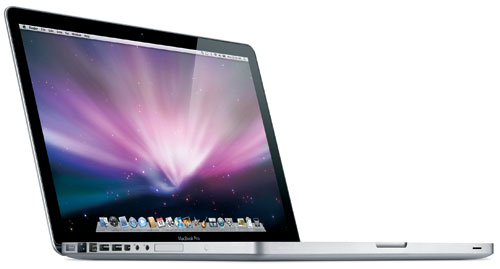
Photo Credit: Apple, Inc. (15-Inch Late 2008 MacBook Pro)
Architecturally, they practically are identical with the significant exception of graphics processors -- as the MacBook models have a "NVIDIA GeForce 9400M with 256 MB of DDR3 SDRAM shared with main memory" and the "Pro" models have dual graphics processors -- a NVIDIA GeForce 9600M GT with dedicated GDDR3 SDRAM and the same NVIDIA GeForce 9400M as the "non-Pro" line.
Additionally, the processors are of similar speed. The "Unibody" MacBook models -- the MacBook "Core 2 Duo" 2.0 13" (Unibody) and MacBook "Core 2 Duo" 2.4 13" (Unibody) -- have 2.0 GHz or 2.4 GHz Core 2 Duo processors -- and the MacBook Pro models -- the MacBook Pro "Core 2 Duo" 2.4 15" (Unibody) and MacBook Pro "Core 2 Duo" 2.53 15" (Unibody) -- have 2.4 GHz or 2.53 GHz Core 2 Duo processors.
With similar processor speeds and effectively the same architecture, one should not expect a substantial difference in overall performance. Graphics performance of the "Pro" line, however, should be substantially superior. For the precise difference, however, real-world testing is required.
Real-World Test Results
In its review of the "Unibody" MacBook Pro models, MacWorld ran Speedmark version 5 tests -- the publication's standard test suite -- and most notably assigned a Speedmark score of 212 to the higher-end MacBook -- the MacBook "Core 2 Duo" 2.4 13" (Unibody) -- and a score of 215 to the lower-end MacBook Pro -- the MacBook Pro "Core 2 Duo" 2.4 15" (Unibody) -- a negligible difference as one would expect for two systems with the same processor. For the high-end MacBook Pro -- the MacBook Pro "Core 2 Duo" 2.53 15" (Unibody) -- MacWorld assigned a score of 231.
In an in-depth review, the Gizmodo blog provides an array of benchmarks and noted that:
Benefits from the previous generation to this one, or from the MB to MBP are slim, often falling below 5% and 10% even in the limited GPU benchmark tests. The differences are there, sure, but the performance gains between the [US]$1600 MacBook and [US]$2500 MacBook Pro are not astounding.
For gaming, however, rather than benchmarks, Gizmodo found that the MacBook "integrated graphics card just doesn't compete" with the dedicated graphics in the MacBook Pro reporting a difference of "more than 50%" in real-world tests.
Focusing primarily on the graphical differences, BareFeats -- never a site to mince words -- wisely summarizes a battery of tests with:
If you are getting a Mac laptop to run Pro Apps with graphics intensive functions, you're going to want a high-end MacBook Pro with the GeForce 9600M GT (or a refurbished MacBook Pro with a GeForce 8600M GT). In my opinion, if your Mac laptop only offers a GeForce 9400M (or GMA X3100) GPU, then expect only to use it for light duty (word processing, email, internet browsing).
Performance Summary
Ultimately, the "Late 2008/Unibody" MacBook and MacBook Pro models are similar in performance for most tasks. For graphics, however, the dedicated NVIDIA GeForce 9600M GT provided by the MacBook Pro pulverizes the integrated NVIDIA GeForce 9400M provided by the MacBook.
In the US, site sponsor Other World Computing sells used and refurb MacBook Pro models at bargain prices with free shipping, as well. On the other hand, if you need to sell a MacBook Pro, A+ BBB-rated Cash for Your Mac and GoRoostr will buy your older notebook with an instant quote and prompt payment.
In the UK, site sponsor Hoxton Macs sells used MacBook Pro models with a one-year warranty and free next day delivery throughout the UK. Delivery across Europe also is available starting at just £9.99 for two-day delivery to France and Germany.
Permalink | Report an Error/Typo | Sign Up for Site Update Notices
<< Unibody MacBook Pro Q&A (Main) | Also See: All MacBook Pro Specs
Established in 1996, EveryMac.com has been created by experts with decades of experience with Apple hardware. EveryMac.com includes, and always has included, original research incorporating detailed, hands-on inspection of packaging, computers, and devices as well as extensive real-world use. All information is provided in good faith, but no website or person is perfect. Accordingly, EveryMac.com is provided "as is" without warranty of any kind whatsoever. EveryMac.com, and the authors thereof, shall not be held responsible or liable, under any circumstances, for any damages resulting from the use or inability to use the information within. For complete disclaimer and copyright information please read and understand the Terms of Use and the Privacy Policy before using EveryMac.com. Copying, scraping, or use of any content without expressed permission is not allowed, although links to any page are welcomed and appreciated.