
Hosted by site sponsor WebMate.
MacBook Air Q&A
Published July 28, 2011
All Mac Q&As >> MacBook Air Q&A (Home) | Also See: All MacBook Air Specs
To be notified of new Q&As, sign up for EveryMac.com's bimonthly email list.
How fast are the "Mid-2011" MacBook Air models compared to one another and to earlier MacBook Air models? How fast are these models compared to the "Early 2011" MacBook Pro models?
Please note that all systems mentioned in this Q&A have been discontinued. However, this Q&A is up-to-date and is quite useful for anyone buying or selling one of these notebooks on the used market.
When the original MacBook Air was released in 2008, it was designed for those more interested in size and weight than performance.
However, with each subsequent model release, the MacBook Air line has become a bit faster, as computers tend to do. The "Mid-2011" MacBook Air line -- the stock models of which are the MacBook Air "Core i5" 1.6 11-Inch (Mid-2011) and "Core i5" 1.7 13-Inch (Mid-2011) -- still are geared toward those who place a premium on size and weight over performance. However, because of significantly faster "Sandy Bridge" processors and a faster internal architecture, the performance bar has been raised considerably.
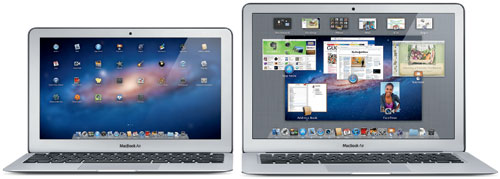
Photo Credit: Apple, Inc. (Left - 11" MacBook Air, Right - 13" MacBook Air)
For previous MacBook Air models, Apple generally has remained mum about overall performance, but for the "Mid-2011" line, the company press release proudly proclaims that it is "up to twice as fast as the previous generation." Likewise, the "Mid-2011" MacBook Air is considerably more competitive with its "Pro" brethren for many tasks as well. To see just how competitive, however, benchmarks and real-world testing are required.
General Performance Overview
For a solid general overview of the performance differences between the "Mid-2011" MacBook Air models and earlier models as well as other Macs, EveryMac.com's own Ultimate Mac Comparison makes it quick to compare side-by-side 32-bit and 64-bit Geekbench benchmark averages with all other G3 and later Macs for thousands of possible performance comparisons.
The Geekbench benchmark shows that the stock MacBook Air "Core i5" 1.6 11-Inch (Mid-2011) is roughly 15% slower than its larger counterpart, the MacBook Air "Core i5" 1.7 13-Inch (Mid-2011).
It also demonstrates that the "Mid-2011" 11-Inch and 13-Inch models are roughly 125% and 100% faster overall than the standard MacBook Air "Core 2 Duo" 1.4 11-Inch (Late 2010) and "Core 2 Duo" 1.86 13-Inch (Late 2010) respectively replaced.
Likewise, Geekbench shows that the standard 13-Inch "Mid-2011" MacBook Air model is in the neighborhood of 10% and 22% slower than the standard 13-Inch "Early 2011" MacBook Pro models -- the MacBook Pro "Core i5" 2.3 13-Inch (Early 2011) and "Core i7" 2.7 13-Inch (Early 2011).
Other Benchmarks & Real-World Test Results
Geekbench provides a convenient overview of overall performance, but a variety of other benchmarks and real-world tests also can be helpful for a well-rounded viewpoint. A number of third-parties with various perspectives follow.
The industry-standard MacWorld ran an assortment of application tests and found overall performance between MacBook Air models to be in line with Apple's estimate. The publication also reported:
The test results on the new 13-inch Airs also show the systems to be stiff competition for the entry-level, [US]$1199 13-inch 2.3 GHz Core i5 MacBook Pro. The flash storage in the Airs is much faster than the hard drives found in the MacBook Pros, and the graphics tests were just a frame or so faster per second on the Pro than on the 13-inch Airs. Zipping the 4 GB folder and importing video from a camera archive into iMovie was faster on the Airs, while iTunes MP3 conversion, as well as HandBrake and iMovie encoding tests, were faster on the MacBook Pro.
The always excellent BareFeats ran benchmark tests as well as application tests with Handbreak, Motion and Portal and succinctly concluded:
Though more than adequate for mere mortal tasks (Safari, Mail, etc.), the 2011 MacBook Air remains at the bottom of the Mac "food chain" when running apps that stress the CPU, GPU and memory.
In the most in-depth testing of all, the always detailed AnandTech compared the "Mid-2011" MacBook Air models to an assortment of MacBook Air and MacBook Pro models from recent years running a variety of applications and noted:
The single threaded performance of the new 11-inch MacBook Air is actually higher than the multithread performance of last year's model. Thanks to Hyper Threading and better performance per core you get around twice the performance of last year's models. Again the Air still isn't as good as the new quad-core MacBook Pros, but if you've got a machine from 2008 the new 13-inch MBA will actually be a performance upgrade (and a more portable machine).
For graphics, however, AnandTech pointed out that because of the lackluster "integrated" Intel HD Graphics 3000 graphics processor the "Mid-2011" models often are slower than the models they replaced. This is most apparent for gaming.
SSD Speed Differences
One potentially disappointing aspect of the "Mid-2011" MacBook Air line from a performance standpoint, as first discovered by YouTube publisher TLDToday, is that Apple is using two different brands of SSDs -- Toshiba and Samsung -- in these models:
As noted in the above video, and reinforced by Engadget, TLDToday found the Toshiba SSD to be slower and the Samsung SSD to be faster. Before purchase there is no way to know which SSD one will receive.
In more precise testing, BareFeats confirmed this speed assessment to be correct overall, but found the Toshiba SSD to actually be faster in some tests. BareFeats also found that neither the Toshiba nor the Samsung were particularly snappy compared to the Mercury Aura Pro Express SSD from site sponsor OWC.
Performance Summary
Ultimately, Apple's overall claim that the "Mid-2011" MacBook Air models are "up to" twice as fast as their predecessors is a reasonable one.
However, an independent and more thorough evaluation concludes that the graphics performance actually is inferior to the "Late 2010" models replaced and even though equipped with much slower hard drives by default, even the slowest "Early 2011" MacBook Pro remains faster than the stock MacBook Air models overall. Nevertheless, the performance of the "Mid-2011" MacBook Air line is solid and most users who value a "thin and light" notebook will be quite pleased with the speed.
In the US, site sponsor Other World Computing sells used and refurb MacBook Air models at bargain prices with free shipping, as well. On the other hand, if you need to sell a MacBook Air, A+ BBB-rated Cash for Your Mac and GoRoostr will buy your older notebook with an instant quote and prompt payment.
In the UK, site sponsor Hoxton Macs sells used MacBook Air models with a one-year warranty and free next day delivery throughout the UK. Delivery across Europe also is available starting at just £9.99 for two-day delivery to France and Germany.
Also see: How much faster are the custom configured Core i7-powered "Mid-2011" MacBook Air models than the stock Core i5-powered models? Is the extra performance worth the extra cost?
Permalink | Report an Error/Typo | Sign Up for Site Update Notices
Established in 1996, EveryMac.com has been created by experts with decades of experience with Apple hardware. EveryMac.com includes, and always has included, original research incorporating detailed, hands-on inspection of packaging, computers, and devices as well as extensive real-world use. All information is provided in good faith, but no website or person is perfect. Accordingly, EveryMac.com is provided "as is" without warranty of any kind whatsoever. EveryMac.com, and the authors thereof, shall not be held responsible or liable, under any circumstances, for any damages resulting from the use or inability to use the information within. For complete disclaimer and copyright information please read and understand the Terms of Use and the Privacy Policy before using EveryMac.com. Copying, scraping, or use of any content without expressed permission is not allowed, although links to any page are welcomed and appreciated.