
Hosted by site sponsor WebMate.
White & Black MacBook Q&A - Revised May 17, 2007
To be notified of new Q&As, sign up for EveryMac.com's bimonthly email list.
What are the differences between the "Late 2006" MacBook Core 2 Duo models?
Please note that the "Late 2006" MacBook Core 2 Duo models were discontinued on May 15, 2007.
The "Late 2006" MacBook Core 2 Duo systems -- the MacBook "Core 2 Duo" 1.83 13-Inch, MacBook "Core 2 Duo" 2.0 13-Inch (White - Late 2006), and MacBook "Core 2 Duo" 2.0 13-Inch (Black) -- have much in common.
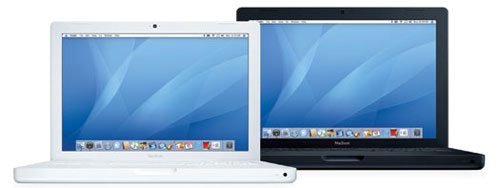
Photo Credit: Apple Computer
All use the same relatively compact and easy to upgrade polycarbonate case introduced by the original MacBook models with the same 13.3-inch "glossy" widescreen display with a 1280x800 native resolution, "flush against the bed" keyboard design, and "catchless" magnetic latch. Each has a "scrolling Trackpad" with "two-finger click" capability, integrated iSight video camera, bundled Apple Remote, and "MagSafe" power connector.
Each additionally has the same connectivity -- AirPort Extreme (802.11g, although the "Late 2006" models are upgradable to 802.11n with a firmware update), Bluetooth 2.0+EDR, Gigabit Ethernet, two USB 2.0 ports, a FireWire "400" port, mini-DVI out (supports an external display up to 1920x1200 pixels), and optical digital audio in/out. None support an internal modem, although an external Apple USB Modem was available for US$49.
Internally, the "Late 2006" MacBook notebooks use a similar logic board with Intel "Core 2 Duo" processors -- each with two independent processor "cores" on a single silicon chip -- a 667 MHz frontside bus, support for 667 MHz DDR2 SDRAM (PC2-5300) RAM, hard drives with "Sudden Motion Sensor" technology that stops the hard drive heads from moving if the notebook is dropped, and integrated graphics -- "the Intel GMA 950 graphics processor with 64MB of DDR2 SDRAM shared with main memory". The entry-level MacBook "Core 2 Duo" 1.83 13-Inch only has 2 MB of shared "on chip" level 2 cache, but the 2.0 GHz models have 4 MB.
Apple quotes a maximum battery life of six hours for all MacBook notebooks with the provided 55-watt-hour battery, although the company estimates 3.5 hours while using wi-fi and 2.5 hours of DVD playback.
The modest differences between the "Late 2006" models -- configuration, color, and price -- are summarized in this handy chart:
| MacBook "Late 2006" | 1.83 | 2.0 (White) | 2.0 (Black) |
|---|---|---|---|
| Intel Processor: | T5600 | T7200 | T7200 |
| Processor Speed: | 1.83 GHz | 2.0 GHz | 2.0 GHz |
| Level 2 Cache: | 2 MB | 4 MB | 4 MB |
| Hard Drive Size: | 60 GB† | 80 GB† | 120 GB† |
| Standard RAM: | 512 MB | 1 GB | 1 GB |
| Optical Capabilities: | 8X "Combo" | 6X DL "SuperDrive" | 6X DL "SuperDrive" |
| Case Color: | White | White | Black |
| Apple Part No: | MA699LL/A | MA700LL/A | MA701LL/A |
| Price: | US$1099 | US$1299 | US$1499 |
†The "Late 2006" MacBook models also could be upgraded at the time of purchase with a 160 GB (5400 RPM) or 200 GB (4200 RPM) hard drive. The 80 GB hard drive in the 2.0 (White) configuration could be upgraded to a 120 GB hard drive for US$150, so the black color alone commanded a US$50 premium.
Please refer to the Ultimate Mac Comparison feature to dynamically compare any MacBook model to any other G3 or later Mac.
Permalink | Report an Error/Typo | Sign Up for Site Update Notices
<< White & Black MacBook Q&A (Main)
Established in 1996, EveryMac.com has been created by experts with decades of experience with Apple hardware. EveryMac.com includes, and always has included, original research incorporating detailed, hands-on inspection of packaging, computers, and devices as well as extensive real-world use. All information is provided in good faith, but no website or person is perfect. Accordingly, EveryMac.com is provided "as is" without warranty of any kind whatsoever. EveryMac.com, and the authors thereof, shall not be held responsible or liable, under any circumstances, for any damages resulting from the use or inability to use the information within. For complete disclaimer and copyright information please read and understand the Terms of Use and the Privacy Policy before using EveryMac.com. Copying, scraping, or use of any content without expressed permission is not allowed, although links to any page are welcomed and appreciated.