
Hosted by site sponsor WebMate.
Unibody MacBook Pro Q&A
Update Published May 10, 2016
All Mac Q&As >> Unibody MacBook Pro Q&A | Also See: All MacBook Pro Specs
To be notified of new Q&As, sign up for EveryMac.com's bimonthly email list.
How do you upgrade the RAM in the 15-Inch "Late 2008/Unibody" MacBook Pro? How much RAM of what type does it support?
Please note that this Q&A is up-to-date and covers the "Late 2008 Unibody" 15-Inch MacBook Pro models. EveryMac.com also provides RAM upgrade instructions for later "Unibody" MacBook Pro models released between "Mid-2009" and "Mid-2012."
Upgrading the memory in the "Late 2008/Unibody" 15-Inch MacBook Pro models is a bit more difficult than it is in the very easy earlier MacBook Pro models, but it still is quite easy.
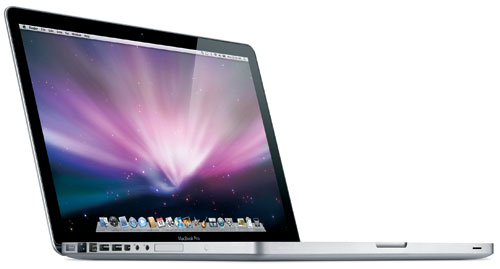
Photo Credit: Apple, Inc. (15-Inch, Late 2008 Unibody MacBook Pro)
Identification Help
If you're not sure whether or not you have a 15-Inch "Late 2008" MacBook Pro or another model, these models -- and for the purpose of a RAM upgrade, the almost identical "Early 2009" models -- can be most readily identified externally via EMC number 2255 on the bottom of the computer. In software, they can be spotted by the MacBookPro5,1 model identifier.
These models also can be identified by the serial number using EveryMac.com's Ultimate Mac Lookup feature.
Supported RAM Types
Apple covers how to install memory in pages 42-49 of the "Unibody" MacBook Pro User Guide (PDF) that provides most of what you need to upgrade the stock memory.
Apple starts by noting that this "Unibody" MacBook Pro:
Have two memory slots that you access by removing the access door, battery, and bottom case. Your MacBook Pro comes with at least 2 GB (1 GB in each slot) of 1066 MHz Double Date Rate (DDR3) Synchronous Dynamic Random-Access Memory (SDRAM) installed.
Both memory slots can accept an SDRAM module that meets the following specifications:
- Double Data Rate Small Outline Dual Inline Memory Module (DDR SO-DIMM) format
- 1.25 inch or smaller (3.18 cm)
- 1 Gigabyte (GB) or 2 Gigabyte (GB)
- 204-pin
- PC3-8500 DDR3 1066 MHz Type RAM
Actual Maximum RAM
Officially, Apple only supports 4 GB of RAM in the "Late 2008/Unibody" MacBook Pro models. Initial tests at the time these models shipped from site sponsor Other World Computing and the always excellent BareFeats demonstrated that they were capable of stably supporting 6 GB of RAM with one 2 GB module and one 4 GB module. It was possible to install 8 GB of RAM as well, but the system was not stable and it was not recommended to install 8 GB of RAM.
However, some time after OWC and BareFeats published their findings, other third-parties reported that these models are capable of stably supporting 8 GB of RAM. In detailed follow up testing, OWC was able to confirm that the "Late 2008" models are capable of supporting 8 GB of RAM, but if -- and only if -- they have been upgraded to run Mac OS X 10.6 "Snow Leopard" and have Boot ROM Version MBP51.007E.B05. Note that you may be required to manually update the firmware for the update to work properly. Earlier versions of the operating system (OWC tested running Mac OS X 10.6.6) and earlier Boot ROM versions are not supported.
To keep life interesting, although the "Early 2009" MacBook Pro Unibody -- the MacBook Pro "Core 2 Duo" 2.66 15" (Unibody) -- also officially supports 4 GB of memory, OWC discovered that this model actually supports a full 8 GB of memory (up from an unofficial 6 GB on the model it replaced) regardless of the operating system installed.
RAM Upgrade Instructions
The Apple manual provides installation instructions complete with drawings -- which absolutely should be read in their entirety before one installs memory -- but even better, OWC provides a convenient step-by-step video of the process:
After watching this video, it should be apparent that upgrading the RAM is simple. However, if you do not feel comfortable -- or have the time -- to perform the upgrade yourself, hiring a professional never is a bad idea.
MacBook Pro RAM Purchase Options
Just because RAM meets the minimum listed criteria does not mean that it will necessarily function as intended in a particular Mac. Be sure to buy from a quality vendor that has tested their RAM with your Mac to ensure full compatibility.
In the US (and many other countries), site sponsor Other World Computing sells memory as well as storage for all MacBook Pro models for do-it-yourself upgrades.
In the UK and Ireland, site sponsor Flexx sells MacBook Pro compatible memory with free shipping. The company provides flat rate shipping to France, Germany, and Switzerland and inexpensive shipping for all of Europe, too.
In Germany, site sponsor CompuRAM sells quality memory for all MacBook Pro models with affordable delivery country-wide and in person pick up and professional installation service available in Munich.
Also see:
- How do you upgrade the RAM in the 17-Inch "Late 2008/Unibody" MacBook Pro? How much RAM of what type does it support?
- How do you upgrade the RAM in the "Mid-2009," "Mid-2010," "Early 2011" and "Late 2011" 13-Inch, 15-Inch, and 17-Inch MacBook Pro models? How much RAM of what type do they support?
Permalink | Report an Error/Typo | Sign Up for Site Update Notices
<< Unibody MacBook Pro Q&A (Main) | Also See: All MacBook Pro Specs
Established in 1996, EveryMac.com has been created by experts with decades of experience with Apple hardware. EveryMac.com includes, and always has included, original research incorporating detailed, hands-on inspection of packaging, computers, and devices as well as extensive real-world use. All information is provided in good faith, but no website or person is perfect. Accordingly, EveryMac.com is provided "as is" without warranty of any kind whatsoever. EveryMac.com, and the authors thereof, shall not be held responsible or liable, under any circumstances, for any damages resulting from the use or inability to use the information within. For complete disclaimer and copyright information please read and understand the Terms of Use and the Privacy Policy before using EveryMac.com. Copying, scraping, or use of any content without expressed permission is not allowed, although links to any page are welcomed and appreciated.