
Hosted by site sponsor WebMate.
iPhone Q&A
Update Published October 4, 2018
All Apple Q&As >> iPhone Q&A (Home)
To be notified of new Q&As, sign up for EveryMac.com's bimonthly email list.
What are all the differences between the iPhone 4 (AT&T/GSM) and the iPhone 4 (Verizon/Sprint/CDMA)? Which one should I buy?
Please note that the iPhone 4 models have been discontinued. However, this Q&A has been updated with up-to-date iOS compatibility and more details and is quite useful for anyone buying or selling an iPhone 4 on the used market.
At first glance, the iPhone 4 models -- the originally released iPhone 4 (GSM) and its similar late model brethren iPhone 4 (GSM, Revision A) -- which both were available exclusively on AT&T in the US, and the iPhone 4 (CDMA), which was available on Verizon and Sprint in the US -- look identical.
However, with close inspection, there are a few differences that are readily apparent as well as a few notable differences in functionality and performance that merit attention.
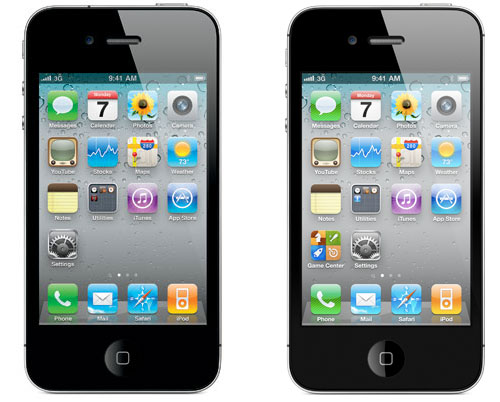
Photo Credit: Apple, Inc. (GSM Models - Left, CDMA Model - Right)
External Differences
All iPhone 4 models use the same general all stainless steel body design and a thin "metal band" that wraps around the sides of each phone. However, the GSM models have an access panel on the right side (and an enclosed Micro SIM card) and the CDMA model does not have an access panel or a SIM card.
Although it can be a bit of a challenge to see in the promotional photos above, the GSM version -- on the left -- also has three antenna "breaks" in the metal band (one on the left third of the top and one on each side toward the bottom) and the CDMA version -- on the right -- has four (two on both sides toward the top and bottom).
In the introductory press conference, Apple's Tim Cook stated that this change merely is related to the CDMA antenna, rather than any effort to improve the GSM model's much ballyhooed "death grip" reception issues. In preliminary testing, MacWorld reported that the reception no longer was an issue whereas AnandTech found that it still was possible to degrade the signal when the CDMA model was held "improperly." AnandTech also noted that the "dual-receive antenna architecture is something that Verizon refers to as 'antenna diversity' and it's a part of Verizon's spec for devices on its network."
In an in-depth review after the device shipped, the always excellent iLounge found that "signal attenuation" still could be an issue for the CDMA iPhone 4 as demonstrated in this video:
For most users, antenna issues were not enough of a problem to discontinue using an iPhone 4 (and insulating any of the GSM or CDMA models with a case will resolve the issue), but it is worth noting that if one finds the antenna to be a problem on a GSM iPhone 4, it is likely that it still would be a problem with a CDMA version as well.
One would have to be extremely precise to be able to tell the difference without the devices side-by-side, but the CDMA version also has the left-hand buttons slightly lower to accommodate the different antenna placement, and this means that some cases that fit the GSM version will not fit properly on the CDMA version without modification if at all.
Identification Differences
One simple way to externally identify the iPhone 4 models, as well as all other iPhone models, is by the Model Number printed in small type on the back of the phone.
The model number printed on the back of the GSM-equipped iPhone 4 models is A1332 and the model number on the back of the CDMA-equipped iPhone 4 is A1349. The subsequently introduced model iPhone 4S -- which looks effectively identical to the iPhone 4 models -- has model number A1387 or A1431 on the back.
If the iPhone will boot, it may be even easier to lookup any of these models by Order Number with Everyi.com's Ultimate iLookup feature. Apple refers to the order number as "Model" in software. To find the "Model" select the "Settings" app and then click General > About > and scroll until the field is visible.
Everyi.com's Ultimate iLookup also can identify these iPhone models by EMC Number and Serial Number, as well.
Functional Differences
From a functional standpoint, the major change is that the GSM-equipped iPhone 4 models support the EDGE "2G" mobile wireless standard as well as 3G networking (7.2 Mbps HSDPA support and HSUPA networks for compatibility with more cellular carriers worldwide). The iPhone 4 (CDMA) model, on the other hand, instead supports CDMA (EV-DO, Rev. A, 800 MHz, 1900 MHz), which means that global coverage is considerably more limited.
Other limitations of the CDMA model include the inability to receive voice and data simultaneously and slower data altogether, the inability to place a call on hold and conference calls are limited to two calls rather than five. These limitations are due to the older CDMA standard rather than the phone itself. Verizon was the first to announce support for a then new "Personal Hotspot" capability that makes it possible to use the iPhone to connect up to five Wi-Fi enabled devices (AT&T offers similar "tethering" capability although it is possible to make and receive calls as well as use the Internet simultaneously).
Battery Life Differences
Battery life also is a bit different due to support of GSM and CDMA networks, respectively. Audio playback, video playback, talk time on 3G, Internet use on Wi-Fi, Internet use on 3G, and standby time all are reported to be the same.
However, the GSM-equipped models can provide an estimated fourteen hours of talk time over a 2G network, whereas the CDMA-equipped model does not support a 2G/EDGE network, and consequently is limited to talk time of 7 hours over a 3G network (which is the same talk time for the GSM model over a 3G network, too).
Device Similarities
Other than the differences enumerated above, the GSM-equipped and CDMA-equipped iPhone 4 models are identical. Experts may prefer to jump to the comparison chart, although others may find the below -- which explains the capabilities that both devices share -- helpful as well.
The iPhone 4 models both have the same high-resolution 960x640 at 326 ppi 3.5", IPS, LED-backlit display with an 800:1 contrast ratio that Apple refers to as a "retina display." The iPhone 4 also has a chemically hardened "aluminosilicate" glass front over both the display and although it was originally announced on June 7, 2010 with a white or black frame and a chemically hardened white or black glass back as well, only black was available for either the GSM-equipped or CDMA-equipped model until April 28, 2011, when both models finally were available in white as well.
The iPhone 4 models have dual cameras -- a 5 megapixel HD video/still camera (720p at 30 FPS) with a "backside illuminated sensor," a 5X digital zoom, and an LED flash on the rear and a VGA quality video/still camera on the front designed for video conferencing over a Wi-Fi network with Apple's included "FaceTime" application. The iPhone 4 has dual noise-canceling microphones as well.
Finally, the iPhone 4 models have a variable speed 1 GHz "Apple A4" processor that commonly runs around 750-800 MHz and 512 MB of RAM, support Bluetooth 2.1+EDR as well as Wi-Fi (802.11b/g in addition to the 2.4 GHz frequency of 802.11n). Both models include an accelerometer, proximity sensors, an ambient light sensor, A-GPS, a digital compass, and a three-axis gyroscope.
Both originally were offered with either 16 GB or 32 GB of storage, but on October 4, 2011, Apple cut the storage to 8 GB (and lowered the price) by introducing a new version of the GSM model -- the iPhone 4 (GSM, Revision A) -- and cutting the storage capacity of the CDMA model. Of course, on the used market, all three capacities are readily available.
iOS Support Similarities
When each originally shipped, the iPhone 4 models were pre-installed with a version of iOS 4 -- iOS 4.0 for the GSM model and 4.2.3 for the CDMA model, specifically. Both models fully support iOS 5, but only partially support iOS 6 and iOS 7. Neither supports iOS 8 or later versions of the iOS at all.
Running iOS 6, the iPhone 4 models do not support the Turn-by-Turn Navigation, Flyover, Panorama, or Siri features or "Made for iPhone" hearing aids, either. They do support the "Offline Reading List" feature, however.
Running iOS 7, the iPhone 4 models do not support AirDrop or Filters in Camera and they still do not support Panorama or Siri. However, these models do support all basic iOS 7 functions -- Control Center, Notification Center, and Multitasking, as well as Safari and iTunes Radio -- in addition to "Filters in Photos" and an assortment of photo functionality that Apple refers to as "Square and video formats and swipe to capture."
It also is worth noting that the iPhone 4 models are notably slower running iOS 7 than iOS 6. Based on hands-on experience and reader feedback, EveryiPhone.com only would recommend running iOS 7 on the iPhone 4 if you are willing to sacrifice speed for new features and more recent app compatibility.
Pricing Similarities
Original pricing in the United States for the GSM-equipped iPhone 4 and CDMA-equipped iPhone 4 essentially were the same. As introduced, AT&T offered the GSM version with 16 GB or 32 GB of storage for US$199 and US$299, respectively. Verizon offered the CDMA version with 16 GB or 32 GB of storage for US$199.99 and US$299.99 (as a minor point, Apple sold the Verizon phone for 99 cents less).
On October 4, 2011, upon introducing the iPhone 4S, Apple also introduced the iPhone 4 (GSM, Revision A) as a new 8 GB variant of the GSM model and lowered the capacity of the CDMA model to 8 GB. These new options were offered for US$99. The GSM version was offered locked to AT&T and the CDMA version was offered locked to either Verizon or Sprint.
On September 12, 2012, alongside the first iPhone 5 models -- the iPhone 5 (GSM/North America), (CDMA), and (GSM/International) -- Apple lowered the price of these locked 8 GB iPhone 4 configurations to US$0 with a two-year contract. AT&T, Verizon and Sprint required a two-year contract for these prices.
The final 8 GB options were discontinued September 10, 2013 with the exception of the mainland China market, where the iPhone 4 was available for RMB 2,588 until September 9, 2014.
For your convenience, the main differences between the iPhone 4 (GSM) and iPhone 4 (CDMA) models also have been summarized below:
 iPhone 4 (GSM) |
 iPhone 4 (CDMA) |
|
|---|---|---|
| Standard Storage: | 8, 16, 32 GB* | 8, 16, 32 GB* |
| GSM/EDGE: | Yes | No |
| UMTS: | Yes | No |
| HSDPA: | Yes | No |
| HSUPA: | Yes | No |
| EV-DO: | No | Yes |
| Personal Hotspot: | No | Yes |
| Talk Time (3G): | 7 Hours | 7 Hours |
| Talk Time (2G): | 14 Hours | None |
| Battery Life (Web - 3G): | 6 Hours | 6 Hours |
| Battery Life (Web - Wi-Fi): | 10 Hours | 10 Hours |
| Battery Life (Music): | 40 Hours | 40 Hours |
| Battery Life (Video): | 10 Hours | 10 Hours |
| Standby Time: | 300 Hours | 300 Hours |
| SIM Card: | Micro | None |
| Original iOS: | iOS 4.0 | iOS 4.2.6 |
| Fastest iOS: | iOS 6 | iOS 6 |
| Maximum iOS: | iOS 7 (Partial) | iOS 7 (Partial) |
| Model No: | A1332 | A1349 |
| Order No (As Introduced): | MC318LL/A, MC319LL/A | MC676LL/A, MC678LL/A |
| Price (As Introduced): | US$199, US$299* | US$199.99, US$299.99* |
*On October 4, 2011, Apple introduced a low-end 8 GB configuration, which EveryiPhone.com documents as iPhone 4 (GSM, Revision A) due to a variety of different identifiers, and discontinued the 16 GB and 32 GB configurations. The 16 GB and 32 GB configurations cost US$199 and US$299, respectively, and the 8 GB model originally was US$99. The 8 GB configuration was cut to US$0 on September 12, 2012 and discontinued on September 10, 2013 in most markets, including the US. The iPhone 4 was discontinued entirely on September 9, 2014. These prices all required a two-year contract in the US.
So, which one should I buy?
At this point, just about everyone should consider a newer iPhone. The iPhone 4 models still can work for phone calls, texts, and simple photography as well as music synchronized from a computer and other basic functions, but because they do not support a recent version of the iOS, app support is limited.
Only those on a very tight budget and very modest expectations for app support -- basically if an older version of an app still works, consider it a pleasant surprise -- should still consider an iPhone 4.
Whether to buy a GSM or CDMA iPhone 4 is your decision, if either, but the devices essentially were the same price originally and tend to be roughly the same price on the used market, too.
If the iPhone 4 meets your needs overall, those who travel globally on a regular basis are more likely to find the GSM model better as the CDMA standard is considered obsolete in many places. On the other hand, the CDMA model is compatible with Verizon and Sprint in the US, both of which often have a reputation for greater reliability than AT&T, whether or not it is justified. The CDMA model may be preferable for those who find reliability to be more important than simultaneous voice and data use, data network speed, or global compatibility. The choice may very well come down to which network is most reliable in your area.
Please also see EveryiPhone.com's Ultimate iComparison feature to dynamically compare any iPhone model to any other iPod, iPhone, or iPad.
Also see:
Permalink | Report an Error/Typo | Sign Up for Site Update Notices
<< iPhone Q&A (Main) | All Apple Q&As
Established in 1996, EveryMac.com has been created by experts with decades of experience with Apple hardware. EveryMac.com includes, and always has included, original research incorporating detailed, hands-on inspection of packaging, computers, and devices as well as extensive real-world use. All information is provided in good faith, but no website or person is perfect. Accordingly, EveryMac.com is provided "as is" without warranty of any kind whatsoever. EveryMac.com, and the authors thereof, shall not be held responsible or liable, under any circumstances, for any damages resulting from the use or inability to use the information within. For complete disclaimer and copyright information please read and understand the Terms of Use and the Privacy Policy before using EveryMac.com. Copying, scraping, or use of any content without expressed permission is not allowed, although links to any page are welcomed and appreciated.