
Hosted by site sponsor WebMate.
Silver Tower Mac Pro (Dual Optical) Q&A - Updated May 22, 2013
All Mac Q&As >> Silver Tower Mac Pro Dual Optical Q&A (Home)
To be notified of new Q&As, sign up for EveryMac.com's bimonthly email list.
How do you upgrade the RAM in the "Early 2009/Nehalem" Mac Pro? What type of RAM does it use? How much RAM does it actually support? How do you install RAM to maximize performance?
Please note that this Q&A explains how to upgrade the RAM in the "Early 2009" Mac Pro models (model identifier MacPro4,1).
EveryMac.com also provides RAM upgrade instructions for other Mac Pro models -- the original Mac Pro (MacPro1,1 and MacPro2,1), "Early 2008" (MacPro3,1), and "Mid-2010" and "Mid-2012" (MacPro5,1) systems.
Just as it is for the original and "Early 2008" Mac Pro models, upgrading the memory in the "Early 2009/Nehalem" Mac Pro line is a simple process. Even though the memory used in the "Early 2009/Nehalem" Mac Pro models do not have the same enormous heatsinks as memory used by earlier Mac Pro models, it nevertheless is critical that the memory meet precise standards and be installed in a particular order to function properly. The "Early 2009" line also can use more RAM than is officially supported, too.
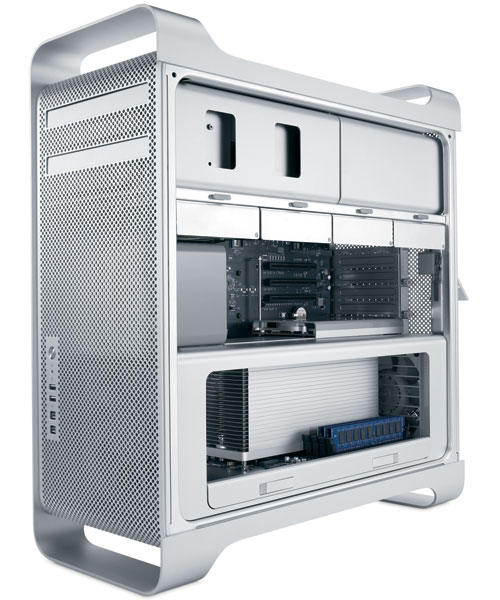
Photo Credit: Apple, Inc. (Early 2009 Mac Pro)
Identification Help
If you're not sure if you have an "Early 2009" Mac Pro or another model, the A1289 Model Number is insufficient as this identifier is shared by several different Mac Pro lines.
However, for the purposes of upgrading the RAM, the "Early 2009" Mac Pro models can be identified properly by the Model Identifier in software and externally by EMC Number. More details about each identifier is provided in EveryMac.com's extensive Mac Identification section.
To locate the model identifier, select "About This Mac" under the Apple Menu on your computer and click the "More Info..." button. If the Mac Pro is running OS X "Lion" (10.7) or later, click the "System Report" button after clicking "More Info..." as well. Regardless of the number of cores, all "Early 2009" Mac Pro models share model identifier MacPro4,1.
The EMC number is located on the rear of the system in small type. As carefully hand documented by EveryMac.com, all "Early 2009" Mac Pro models share EMC number 2314.
Specifically, these systems are "Early 2009" Mac Pro models:
Mac Pro |
Subfamily |
Model ID |
EMC Number |
Early 2009 |
|||
Early 2009 |
|||
Early 2009 |
|||
Early 2009 |
|||
Early 2009 |
|||
Early 2009 |
EveryMac.com's Ultimate Mac Lookup feature also can identify these models by their Serial Numbers.
RAM Type, Actual Maximum Capacity, & Performance Details
The "Early 2009/Nehalem" Mac Pro models use "1066 MHz DDR3 ECC SDRAM", but more specifically must conform to the following specifications:
- PC3-8500, 1066 MHz, DDR3 SDRAM UDIMMs
- Error-correcting code (ECC)
- 72-bit wide, 240-pin ECC modules
- 36 ICs maximum per ECC UDIMM
Please note that the low-end "Quad Core" models -- Mac Pro "Quad Core" 2.66 (2009), "Quad Core" 2.93 (2009) and "Quad Core" 3.33 (2009) -- have four memory slots. By contrast, the high-end "Eight Core" models -- Mac Pro "Eight Core" 2.26 (2009), Mac Pro "Eight Core" 2.66 (2009) and Mac Pro "Eight Core" 2.93 (2009) -- have eight memory slots.
Officially, starting December 4, 2009, Apple supports 16 GB of RAM in the "Quad Core" models and 32 GB of RAM in the "Eight Core" models using 4 GB memory modules.
However, site sponsor OWC first discovered that the "Quad Core" models actually were able to support 32 GB of RAM (in both 32-bit and 64-bit mode) and later increased this maximum to 48 GB of RAM.
Likewise, OWC first discovered the "Eight Core" models could support 64 GB of RAM when booting the system in 64-bit mode running Mac OS X 10.5 "Leopard" and later increased this maximum to 96 GB of RAM running Mac OS X 10.6 "Snow Leopard" or later versions of OS X. More recently, OWC yet again discovered these "Eight Core" models can support up to 128 GB, but only when running a 64-bit version of Windows XP or later or Linux. Mac OS X only can support 96 GB of RAM.
From testing both systems, the always excellent BareFeats reported that three memory modules in the Mac Pro "Quad Core" 2.66 (2009/Nehalem) and six memory modules in the Mac Pro "Eight Core" 2.26 (2009/Nehalem) are faster than the maximum of four and eight modules, respectively. This is because each Nehalem processor has three memory controllers, so it is slower for the processor to access the fourth one. However, BareFeats noted that the "vast majority of real world applications do not saturate the memory bandwidth" so it wouldn't necessarily be slower to maximize the memory.
Apple covers installing memory in the "Early 2009" Mac Pro models on pages 41-58 of the PDF User's Guide -- complete with drawings -- and this absolutely should be read before upgrading the memory.
However, OWC noticed the manual and the Memory Slot Utility software that is pre-installed on the "Early 2009" Mac Pro provide contradictory information about which slots should be populated to maximize performance. For maximum speed, use the information provided by the application rather than the manual.
Perhaps even better than the official drawings, OWC also provides a step-by-step video of the upgrade process:
From watching the above video, it is clear that upgrading the RAM in the "Early 2009" Mac Pro is quick and easy. However, if you do not feel comfortable -- or have the time -- to upgrade the RAM yourself, professional installation always is a good idea.
Mac Pro RAM Purchase & Professional Installation Options
Just because RAM meets the minimum listed criteria does not mean that it will necessarily function as intended in your Mac. Be sure to buy from a quality vendor that has tested their RAM with the Mac Pro to ensure full compatibility.
In the US (and many other countries), site sponsor Other World Computing sells memory compatible with all Mac Pro models (and all other Macs).
In the UK and Ireland, site sponsor Flexx sells Mac Pro compatible memory with free shipping. The company provides flat rate shipping to France, Germany, and Switzerland and inexpensive shipping for all of Europe, too.
In Germany, site sponsor CompuRAM sells quality memory for all Mac Pro models with affordable delivery country-wide and in person pick up and professional installation service available in Munich.
Also see:
- How do you upgrade the RAM in the original Mac Pro? What type of RAM does it use? How much RAM does it actually support?
- How do you upgrade the RAM in the "Early 2008" (Harpertown/Penryn) Mac Pro? What type of RAM does it use? How much RAM does it actually support? Is it backwards compatible with RAM from the original Mac Pro?
- How do you upgrade the RAM in the "Mid-2010" and "Mid-2012" (Nehalem/Westmere) Mac Pro models? What type of RAM do these models use? How much RAM do they actually support?
Permalink | Report an Error/Typo | Sign Up for Site Update Notices
<< Mac Pro Dual Optical Drives Q&A (Main) | All Mac Q&As
Established in 1996, EveryMac.com has been created by experts with decades of experience with Apple hardware. EveryMac.com includes, and always has included, original research incorporating detailed, hands-on inspection of packaging, computers, and devices as well as extensive real-world use. All information is provided in good faith, but no website or person is perfect. Accordingly, EveryMac.com is provided "as is" without warranty of any kind whatsoever. EveryMac.com, and the authors thereof, shall not be held responsible or liable, under any circumstances, for any damages resulting from the use or inability to use the information within. For complete disclaimer and copyright information please read and understand the Terms of Use and the Privacy Policy before using EveryMac.com. Copying, scraping, or use of any content without expressed permission is not allowed, although links to any page are welcomed and appreciated.