
Hosted by site sponsor WebMate.
iPhone Q&A
Revision Published October 1, 2019
All Apple Q&As >> iPhone Q&A (Home)
To be notified of new Q&As, sign up for EveryMac.com's bimonthly email list.
What are all the differences between the iPhone 4, the iPhone 4S, and the iPhone 5? Are these older models still worth considering?
Please note that the iPhone 4, iPhone 4S, and iPhone 5 all have been discontinued. However, this Q&A has been updated with the latest iOS support and other differences and more details and can be quite useful for anyone buying or selling one of these models on the used market.
With even the most cursory of glances at an iPhone 5 model -- the iPhone 5 (GSM/North America), (GSM/CDMA), (GSM/International), (CDMA China), or (GSM AWS/North America) -- either of the iPhone 4S* models -- the iPhone 4S or iPhone 4S (GSM China) -- or any of the iPhone 4 models -- the iPhone 4 (GSM), iPhone 4 (GSM, Revision A), or iPhone 4 (CDMA) -- one would immediately notice that the iPhone 5 is taller and the rear is primarily aluminum rather than glass like the iPhone 4S and iPhone 4, at least if the devices are side-by-side.
Although the dimensions and materials are noteworthy differences between these devices, there are many other differences that are equally worthwhile.
*For those interested in the smallest of details, Apple formally changed the name of the iPhone 4S to 4s (lower case "s") on September 10, 2013. As this EveryiPhone.com Q&A first was published prior to this change, it will continue to refer to this model as the iPhone 4S for simplicity.
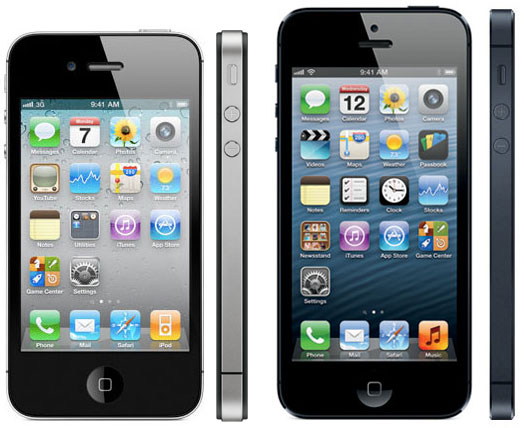
Photo Credit: Apple, Inc. -- iPhone 4(S), Left; iPhone 5, Right
External Differences
The iPhone 5 configurations have a 4" (diagonal) widescreen multi-touch IPS LED-backlit 1136x640 native resolution (326 ppi) "Retina" display, which has "integrated touch technology" so the pixels themselves act as a touch-sensitive digitizer. The iPhone 4 and iPhone 4S models likewise have a multi-touch IPS LED-backlit "Retina" display, and it likewise is 326 ppi, but the display is only 3.5" 960x640, so it's shorter but the same width. The iPhone 4 and iPhone 4S have a separate touch sensitive digitizer, which is one reason they are thicker.
Size-wise, the iPhone 5 configurations are only 0.30 of an inch (7.6 mm) thick and weigh 3.95 ounces (112 g), which Apple proudly proclaims is "18% thinner and 20% lighter" than the iPhone 4S. In person, the iPhone 5 is so light it almost feels hollow or fake, but you get used to it in time. By comparison, the iPhone 4S is 0.37 of an inch thick and is a comparatively hefty 4.9 ounces (140 g). The iPhone 4 models are the same dimensions as the iPhone 4S but weigh slightly less -- 4.8 ounces (137 g).
The iPhone 5 has a largely aluminum housing with "diamond cut" chamfered aluminum around the sides and a mostly aluminum back offered in either a matte black finish or a matte silver finish and corresponding glossy black or white glass fronts. By contrast, the iPhone 4 and iPhone 4S models use the same general stainless steel body design and likewise have a thin metal "band" that wraps around the sides of each phone. However, both the front and back are black or white glass, which adds considerably to relative thickness and weight.
Finally, the iPhone 5 has a bottom mounted headphone jack and a smaller, easier-to-use USB 2.0-based "Lightning" port to connect the iPhone 5 to a computer, power adapter, or stereo, as well as built-in speakers and three noise canceling microphones. The iPhone 4 and iPhone 4S models have a more convenient top mounted headphone jack and a larger, but more finicky, 30-pin "Dock Connector" that provides much greater compatibility with iPhone-compatible devices made since its inception in 2007, as well as smaller built-in speakers and two noise canceling microphones.
All iPhone 5 models, even the "CDMA" models (which support an assortment of GSM connectivity, too), have an access panel on the right side of the metal band for the enclosed tiny Nano SIM card (or UIM for the China-only model), whereas the the iPhone 4S models and the iPhone 4 (GSM) likewise have an access panel in roughly the same place, but they use the now older Micro SIM standard. The iPhone 4 (CDMA) does not have an access panel or a SIM card.
The iPhone 4 (GSM) has three antenna "breaks" in the metal band (one on the top and one on each side toward the bottom) whereas the iPhone 4 (CDMA), iPhone 4S, and iPhone 5 have four (two on both sides toward the top and bottom).
Camera Differences
The iPhone 4, iPhone 4S, and iPhone 5 all have dual cameras, but there are important quality differences between them.
The iPhone 5 and iPhone 4S both have a rear 8 megapixel camera, which includes support for 1080p 30 FPS video recording and Panorama mode. However, the iPhone 5 rear camera has better video stabilization, the ability to take still photos while also recording video, and face detection. It is worth noting, however, that the rear camera on the iPhone 5 is only modestly better than the rear camera in the iPhone 4S in many real-world tests.
The iPhone 5 additionally has a front 1.2 megapixel, 720p "FaceTime HD" camera whereas the iPhone 4S only has a VGA quality front-facing camera, both intended primarily for use with FaceTime video conferencing.
By contrast, the rear camera on the iPhone 4 only is capable of shooting 5 megapixel still photos and 720p 30 FPS video and it has the same VGA quality front-facing camera as the iPhone 4S.
Identification Differences
Although the aluminum back on the iPhone 5 initially made it easy to spot, this has become more difficult with the introduction of subsequent models.
Consequently, one simple way to identify the iPhone 4, iPhone 4S, and iPhone 5 models, as well as collectively differentiate them from all other iPhone models, is by referencing the Model Number listed in small type on the back of the phone.
The relevant model numbers are:
Given the above, it clearly is not possible to differentiate between the iPhone 5 devices by model number alone, but for the purpose of this Q&A, it is sufficient to note that A1428, A1429, and A1442 refer to the iPhone 5 rather than another iPhone model. EveryiPhone.com also provides an in-depth evaluation of the differences between the iPhone 5 configurations that may be of interest.
EveryiPhone.com's Ultimate iLookup feature also can precisely identify these iPhone models by Order Number (referred to as "Model" within the iOS "Settings" app under General > About), and their Serial Numbers, as well.
Battery Life Differences
Apple reports that all of these devices provide an estimated maximum of 40 hours of audio playback and 10 hours of video playback, but provide different numbers for voice, mobile Internet, and Wi-Fi use:
| iPhone 4 | iPhone 4S | iPhone 5 | |
| Talk Time (3G) | 7 Hours | 8 Hours | 8 Hours |
| Internet Use (3G) | 6 Hours | 6 Hours | 8 Hours |
| Internet Use (4G/LTE) | None | None | 8 Hours |
| Internet Use (Wi-Fi) | 10 Hours | 9 Hours | 10 Hours |
Of course, these Apple-provided estimates are for performing a single task. In the real-world, one is likely to mix different tasks and battery conservation can be quite useful.
Wireless Connectivity & Data Differences
Wireless connectivity is quite different amongst the iPhone 4, iPhone 4S, and iPhone 5.
The iPhone 5 models are the only ones to mostly support 4G/LTE, although the bands supported by different configurations vary. Specifically, the A1428 iPhone 5 (GSM/North America) and (GSM AWS/North America) support LTE bands 4 and 17 (and the AWS model adds AWS support on carriers that support the standard), the CDMA A1429 iPhone 5, supports LTE bands 1, 3, 5, 13, and 25, the "International" GSM A1429 iPhone 5, supports LTE bands 1, 3, and 5. The A1442 iPhone 5 (CDMA China/UIM/WAPI) does not support LTE.
All iPhone 5 models support UMTS/HSPA+/DC-HSDPA (850, 900, 1900, 2100 MHz), and GSM/EDGE (850, 900, 1800, 1900 MHz), but only the A1429 CDMA version supports CDMA EV-DO Rev. A and Rev. B (800, 1900, 2100 MHz). The A1442 China-only model does not support 2100 MHz CDMA EV-DO.
The iPhone 4S models support both GSM and CDMA networks -- UMTS/HSDPA/HSUPA (850, 900, 1900, 2100 MHz), GSM/EDGE (850, 900, 1800, 1900 MHz), and CDMA EV-DO Rev. A (800, 1900 MHz). HSDPA is up to a theoretical maximum of 14.4 Mbps.
The earlier iPhone 4 models, support either GSM or CDMA networks, but not both, and each device only supports a maximum theoretical HSDPA download speed of 7.2 Mbps.
All three models support 802.11n Wi-Fi, although the iPhone 4 and iPhone 4S only support it on the 2.4 GHz frequency and the iPhone 5 supports both the 2.4 GHz and 5 GHz frequency. The iPhone 5 and iPhone 4S support Bluetooth 4.0 and GLONASS in addition to GPS, whereas the older iPhone 4 only supports Bluetooth 2.1+EDR and GPS, without its former Soviet counterpart. The China-only iPhone 5 and iPhone 4S models add "WAPI" support as required by the Chinese government, as well.
Unfortunately, it also is worth noting that Apple disabled the CDMA capability on unlocked iPhone 4S models purchased in the United States. As first discovered by iDownloadBlog, the Verizon iPhone 5 model was sold unlocked, albeit with a two year contract, but this still made it the top choice for Americans interested in traveling outside of the US. The iPhone 5 (GSM/LTE/AWS/North America) was offered on T-Mobile unlocked but generally bound by a contract, as well.
Internal Differences
The iPhone 5 packs a "twice" as fast dual core 1.3 GHz Apple A6 processor as well as 1 GB of RAM, compared to the iPhone 4S -- which has a 1 GHz dual core Apple A5 processor and 512 MB of RAM -- and the iPhone 4, which has a single core 1 GHz Apple A4 processor and 512 MB of RAM.
Although capacities have shifted over the years, the iPhone 4 models originally were offered with 16 GB and 32 GB of storage and the iPhone 4S models originally were offered with 16 GB, 32 GB, and 64 GB of storage. Later, both models were offered with 8 GB of storage. Of course, on the used market, all of these capacities are readily available.
The iPhone 5 was offered with 16 GB, 32 GB, or 64 GB of storage.
iOS Support & Software Differences
The iPhone 4, iPhone 4S, and iPhone 5 models all are capable of running iOS 6 and iOS 7, but only the iPhone 5 fully supports all features on both versions of the operating system.
The iPhone 5 fully supports all features on iOS 8 and iOS 9 and it supports iOS 10, also, but it does not support the Raise to Wake and Rich Notifications features. The iPhone 5 does not support iOS 11 or later versions of the iOS at all.
The iPhone 4 only partially supports iOS 6 and iOS 7 and does not support iOS 8 at all, whereas the iPhone 4S fully supports iOS 6; partially supports iOS 7, iOS 8, and iOS 9; and does not support iOS 10 at all:
| iPhone 4 | iPhone 4S | iPhone 5 | |
| iOS 6 Support | Partial | Complete | Complete |
| iOS 7 Support | Partial | Partial | Complete |
| iOS 8 Support | None | Partial | Complete |
| iOS 9 Support | None | Basic | Complete |
| iOS 10 Support | None | None | Partial |
| iOS 11 Support | None | None | None |
None of these models support iOS 12 or later versions of the iOS, including the current version, either.
Perhaps most notably, regardless of OS version, the iPhone 4 cannot run "Siri," Apple's "intelligent assistant" software program that makes an effort to answer questions, find nearby businesses -- it seems to be particularly adept at locating burritos -- and perform basic tasks like setting an alarm or entering a calendar appointment. Running iOS 6, the iPhone 4 also does not support Turn-By-Turn Navigation and Flyover as well as other more minor features.
Likewise, when running iOS 7, the iPhone 4 and iPhone 4S support all basic functionality, but most notably, these devices do not support the added AirDrop or "Filters in Camera" features like the iPhone 5.
Running iOS 8, the iPhone 4S most notably does not support the "Continuity" feature. It also is a bit slower running iOS 8 than it is running iOS 7 and it is even slower running iOS 9. The iPhone 5 is noticeably slower running iOS 9 or iOS 10 than iOS 8, as well.
Comparison Chart
These differences -- display, materials, connectivity, cameras, identifiers, battery life, processor, storage, and iOS support -- along with original pricing information are summarized below for your convenience:
iPhone |
 4 (GSM/CDMA) |
 4S |
 5 |
|---|---|---|---|
| Intro Date: | Jun. 7, 2010 | Oct. 4, 2011 | Sep. 12, 2012 |
| Disc Date: | Sep. 10, 2013 | Sep. 10, 2013 | Sep. 10, 2013 |
| Display: | 3.5" | 3.5" | 4" |
| Resolution: | 960x640 | 960x640 | 1136x640 |
| Processor: | Apple A4 | Apple A5 | Apple A6 |
| Cores: | Single Core | Dual Cores | Dual Cores |
| Storage: | 8, 16, 32 GB | 8, 16, 32, 64 GB | 16, 32, 64 GB |
| RAM: | 512 MB | 512 MB | 1 GB |
| GSM/EDGE: | Yes/No | Yes | Yes |
| UMTS: | Yes/No | Yes | Yes |
| HSDPA: | Yes (7.2 Mbps)/No | Yes (14.4 Mbps) | Yes (DC-HSPDA) |
| HSUPA: | Yes/No | Yes | Yes |
| EV-DO: | No/Yes | Yes | No/Yes |
| 4G/LTE: | No | No | Yes/No (China Only) |
| Bluetooth: | 2.1+EDR | 4.0 | 4.0 |
| GPS: | GPS | GPS/GLONASS | GPS/GLONASS |
| 802.11n: | 2.4 GHz | 2.4 GHz | 2.4 GHz/5 GHz |
| Talk Time (3G): | 7 Hours | 8 Hours | 8 Hours |
| Talk Time (2G): | 14 Hours/No | 14 Hours | N/A |
| Battery (Web - 3G): | 6 Hours | 6 Hours | 8 Hours |
| Battery (Wi-Fi): | 10 Hours | 9 Hours | 10 Hours |
| Battery (Music): | 40 Hours | 40 Hours | 40 Hours |
| Battery (Video): | 10 Hours | 10 Hours | 10 Hours |
| Standby Time: | 300 Hours | 200 Hours | 225 Hours |
| SIM Card: | Micro/None | Micro | Nano |
| Connector: | Dock (30-Pin) | Dock (30-Pin) | Lightning |
| Headphone Jack: | Top-Mounted | Top-Mounted | Bottom Mounted |
| Original OS: | iOS 4.0/4.3 | iOS 5 | iOS 6 |
| Fastest OS: | iOS 6 | iOS 7 | iOS 8 |
| Maximum OS: | iOS 7 (Partial) | iOS 9 (Basic) | iOS 10 (Partial) |
| Siri Support: | No | Yes | Yes |
| AirDrop Support: | No | No | Yes |
| Continuity Support: | No | No | Yes |
| Transit (iOS 9): | No | No | Yes |
| Still Camera: | 5 Megapixels | 8 Megapixels | 8 Megapixels |
| Video Camera: | 720p | 1080p | 1080p |
| FaceTime Camera: | VGA | VGA | 720p |
| Materials: | Glass/Steel | Glass/Steel | Glass/Aluminum |
| Dimensions: | 4.5 x 2.31 x 0.37* | 4.5 x 2.31 x 0.37* | 4.87 x 2.31 x 0.30* |
| Weight: | 4.8 oz. (137 g) | 4.9 oz. (140 g) | 3.95 oz. (112 g) |
| Model No: | A1332/A1349 | A1387/A1431 | A1428/A1429/A1442 |
| Intro Price: | US$199, $299† | US$199, $299† | US$199, $299, $399† |
* In inches, height x width x depth.
† These prices all require, or required, a two-year contract in the US. Unlocked and contract free iPhone models were available at a premium.
For intro pricing in dozens of other countries, see the "Global Prices" on the specs page for each iPhone as well as the "By Global Original Prices" section of Everyi.com.
So, which iPhone model is best for my needs? Is one of these older models still worth considering?
If you've decided that you want an iPhone -- rather than a cheap new Android smartphone -- and you would like to buy a used iPhone model to save some money, the iPhone 5 is the best option of the three. It is newer, more capable, and supports a newer version of the iOS.
With that said, none of these models -- the iPhone 4, iPhone 4S, or iPhone 5 -- support the current version of the iOS. Accordingly, app support has started to wane, especially for the iPhone 4 and iPhone 4S that max out at iOS 7 and iOS 9, respectively, but the iPhone 5 still has a bit of life left.
If you have a bit higher budget, you might also want to review the differences between the iPhone 5 and the newer iPhone 5s and iPhone SE, which also are available on the used market at modestly higher prices and support newer versions of the iOS.
Regardless of the chosen iPhone, keep in mind that in many countries, particularly if the device is locked, most of the cost is tied to usage, rather than the upfront price. Make sure that the operating costs are within your budget, as well.
The iPhone 5 has a modestly larger screen, but because the housing is thinner and lighter than the iPhone 4 and iPhone 4S, the iPhone 5 doesn't really "feel" much bigger overall. The aluminum iPhone 5 housing also generally is more durable than the glass iPhone 4/4S housing, although it is more subject to nicks and scratches, so much so that some were scratched before even leaving the factory and it is a safe bet that many used models will have signs of wear. In addition to the display and housing, most notably, the iPhone 5 also is significantly faster than the iPhone 4 and iPhone 4S, has faster 4G/LTE networking support (with the exception of the China only model), and it has better cameras, too.
Please also see EveryiPhone.com's Ultimate iComparison feature to dynamically compare any iPhone model to any other iPod, iPhone, or iPad.
Also see:
Permalink | Report an Error/Typo | Sign Up for Site Update Notices
<< iPhone Q&A (Main) | All Apple Q&As
Established in 1996, EveryMac.com has been created by experts with decades of experience with Apple hardware. EveryMac.com includes, and always has included, original research incorporating detailed, hands-on inspection of packaging, computers, and devices as well as extensive real-world use. All information is provided in good faith, but no website or person is perfect. Accordingly, EveryMac.com is provided "as is" without warranty of any kind whatsoever. EveryMac.com, and the authors thereof, shall not be held responsible or liable, under any circumstances, for any damages resulting from the use or inability to use the information within. For complete disclaimer and copyright information please read and understand the Terms of Use and the Privacy Policy before using EveryMac.com. Copying, scraping, or use of any content without expressed permission is not allowed, although links to any page are welcomed and appreciated.