
Hosted by site sponsor WebMate.
Aluminum "Unibody" Mac mini Q&A
Update Published November 21, 2018
All Mac Q&As >> Aluminum Mac mini Q&A (Home)
To be notified of new Q&As, sign up for EveryMac.com's bimonthly email list.
How do you upgrade the RAM in the Aluminum "Unibody" Mac mini models? What type of RAM do they use? How much RAM do they actually support? Is it even possible to upgrade the RAM?
There are five different lines of Aluminum "Unibody" Mac mini models -- the "Mid-2010", "Mid-2011", "Late 2012", "Late 2014" and "Late 2018" -- all of which are quite different from one another in terms of memory.
Although the memory types are different, the upgrade procedure for the "Mid-2010", "Mid-2011" and "Late 2012" Mac mini lines is easy and essentially the same and it is quite similar for the current "Late 2018" models, as well. Unlike vintage polycarbonate Mac mini models, which require one to pry open the case and are not easy to upgrade, these Aluminum Mac mini models have a black plastic base on the bottom that can be removed with a quick turn to access the RAM slots.
Unfortunately, as first reported by Macminicolo and confirmed by site sponsor OWC, the now discontinued "Late 2014" Mac mini models have soldered RAM. These models could be upgraded to as much as 16 GB of RAM at the time of system purchase, but the RAM cannot be upgraded later at all. In a pleasant surprise, Apple returned to upgradable memory for the current "Late 2018" Mac mini models (sadly the storage is onboard, though).
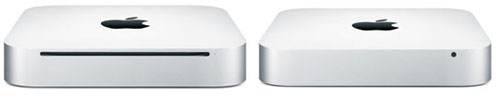
Photo Credit: Apple, Inc. (Non-Server Mid-2010 - Left, 2011-2014 Models - Right)
If you're not sure which Aluminum Mac mini model you have, these models can be identified by the Model Identifier in software and externally by EMC Number for the purposes of upgrading the RAM. More details about specific identifiers are provided in EveryMac.com's extensive Mac Identification section.
To locate the model identifier in software, select "About This Mac" under the Apple Menu on your computer and click the "More Info..." button. If the Mac mini is running OS X 10.7 "Lion" or later, you will need to click the "System Report" button after clicking "More Info..." as well. EveryMac.com has carefully hand documented each model identifier for your convenience.
For the pre-Late 2014 Mac mini models, the EMC number is visible upon removing the bottom "spin off" panel to the right of the memory slots (when the ports are facing you). It is on the bottom of the "Late 2014" and "Late 2018" models toward the ports. As always, EveryMac.com has hand documented the EMC numbers unique to each series, too.
These identifiers are most easily visualized as a chart:
Alu. Mac mini |
Subfamily |
Model ID |
EMC No. |
Mid-2010 |
|||
Mid-2010 |
|||
Mid-2010 |
|||
Mid-2011 |
|||
Mid-2011 |
|||
Mid-2011 |
|||
Mid-2011 |
|||
Late 2012 |
|||
Late 2012 |
|||
Late 2012 |
|||
Late 2012 |
|||
Late 2012 |
|||
Late 2014 |
|||
Late 2014 |
|||
Late 2014 |
|||
Late 2014 |
|||
Late 2018 |
|||
Late 2018 |
|||
Late 2018 |
EveryMac.com's Ultimate Mac Lookup feature also can identify these models by their Serial Numbers.
RAM Types & Actual Maximum RAM Capacities
The "Mid-2010" Mac mini models have two memory slots that support 1066 MHz PC3-8500 DDR3 SO-DIMMs. Originally, they both officially and unofficially supported a maximum of 8 GB of RAM with two 4 GB memory modules. However, as discovered more recently by site sponsor Other World Computing, if these systems are running OS X 10.7.5 or higher, have been updated to use the latest EFI, and are equipped with proper specification memory modules, they can support up to 16 GB of RAM with dual 8 GB memory modules.
The "Mid-2011" Mac mini models likewise have two memory slots but instead support faster 1333 MHz PC3-10600 DDR3 SO-DIMMs. Officially, these models only support 8 GB of RAM, but as also reported by OWC, they likewise are capable of supporting 16 GB of RAM with dual 8 GB memory modules. These models only run OS X 10.7 and later versions of the operating system.
The "Late 2012" Mac mini models also have two memory slots but use faster still 1600 MHz PC3-12800 DDR3 SO-DIMMs. At least for now, they both officially and unofficially support 16 GB of RAM, but should this number increase in the future (Intel reports that the underlying chipset can support up to 32 GB of RAM), this EveryMac.com Q&A will be updated.
Unfortunately, the "Late 2014" Mac mini models have soldered RAM that cannot be upgraded after the initial system purchase. By default, these models have 4 GB or 8 GB of 1600 MHz "Low Power" LPDDR3 SDRAM onboard, and this can be upgraded to 16 GB, but only at the time of initial purchase. The RAM in these models cannot be upgraded later.
The current "Late 2018" Mac mini models triumphantly return with two memory slots and use even faster 2666 MHz PC4-21300 DDR4 SO-DIMMs. They support as much as 64 GB of RAM with two 32 GB memory modules.
Much like the identification help, the details are most easily visualized as a chart:
Alu. Mac mini |
Subfamily |
Model ID |
SO-DIMM |
Max |
Mid-2010 |
1066 PC3-8500 |
16 GB* |
||
Mid-2010 |
1066 PC3-8500 |
16 GB* |
||
Mid-2010 |
1066 PC3-8500 |
16 GB* |
||
Mid-2011 |
1333 PC3-10600 |
16 GB† |
||
Mid-2011 |
1333 PC3-10600 |
16 GB† |
||
Mid-2011 |
1333 PC3-10600 |
16 GB† |
||
Mid-2011 |
1333 PC3-10600 |
16 GB† |
||
Late 2012 |
1600 PC3-12800 |
16 GB |
||
Late 2012 |
1600 PC3-12800 |
16 GB |
||
Late 2012 |
1600 PC3-12800 |
16 GB |
||
Late 2012 |
1600 PC3-12800 |
16 GB |
||
Late 2012 |
1600 PC3-12800 |
16 GB |
||
Late 2014 |
Soldered RAM‡ |
16 GB‡ |
||
Late 2014 |
Soldered RAM‡ |
16 GB‡ |
||
Late 2014 |
Soldered RAM‡ |
16 GB‡ |
||
Late 2014 |
Soldered RAM‡ |
16 GB‡ |
||
Late 2018 |
2666 PC4-21300 |
64 GB |
||
Late 2018 |
2666 PC4-21300 |
64 GB |
||
Late 2018 |
2666 PC4-21300 |
64 GB |
* Officially, the "Mid-2010" models support 8 GB of RAM, but they actually can support 16 GB of RAM. However, this is if and only if they are running OS X 10.7.5 or higher, have been updated to use the latest EFI, and are equipped with proper specification memory modules.
† Officially, the "Mid-2011" line supports 8 GB of RAM, but they actually support 16 GB.
‡ The "Late 2014" Mac models support a maximum of 16 GB of onboard 1600 MHz "Low Power" LPDDR3 SDRAM, but only if configured with 16 GB at the time of system purchase. The RAM cannot be upgraded later.
For polycarbonate Mac mini models, Apple does not provide instructions or recommend that users upgrade their own memory. However, for the Aluminum Mac mini, the company provides instructions on pages 31-38 and 39-46 of the "Mid-2010" and "Mid-2011" User's Guides, respectively. Apple does not provide instructions in the "Quickstart Guide" for the "Late 2012" models, but the procedure is the same. Apple likewise does not provide instructions for the current "Late 2018" models, but it is a similar process, as well.
When available, the manuals provide installation instructions complete with drawings, which absolutely should be reviewed in their entirety before one installs memory. However, the below videos may be even better.
Mid-2010 Mac mini RAM Upgrade Videos
This video -- from YouTube user DetroitBORG -- specifically covers the optical drive-equipped "Mid-2010" (Macmini4,1) models:
Mid-2011 & Late 2012 Mac mini RAM Upgrade Video
OWC provides an exact video covering the slotless "Mid-2011" (Macmini5,1, Macmini5,2, Macmini5,3), and "Late 2012" (Macmini6,1, Macmini6,2) models, too:
Late 2018 Mac mini RAM Upgrade Video
Finally, OWC provides a specific video for the current "Late 2018" (Macmini8,1) models:
After watching these videos, it should be clear that upgrading the RAM is a simple procedure in aluminum Mac mini models released prior to and after the Mid-2014 series.
However, even though the RAM upgrade procedure is simple (when possible), if you do not feel comfortable -- or have the time -- to perform the upgrade yourself, hiring a professional always is a good option.
Mac mini RAM Purchase Options
Just because RAM meets the minimum listed criteria does not mean that it will necessarily function as intended in your Mac. Be sure to buy from a quality vendor that has tested their RAM with the Mac mini to ensure full compatibility.
In the US (and many other countries), site sponsor Other World Computing sells memory compatible with all of the Mac mini models and provides a professional upgrade service for the Mac mini, too.
In Germany, site sponsor CompuRAM sells quality memory for all Mac mini models with affordable delivery country-wide and in person pick up and professional installation service available in Munich.
Also see:
- How do you upgrade the hard drive(s) in the Aluminum "Unibody" Mac mini models? What type of hard drive or SSDs do they support?
- How do you upgrade the RAM in the Polycarbonate Intel Mac mini models? What type of RAM do they use? How much RAM do they actually support?
Permalink | Report an Error/Typo | Sign Up for Site Update Notices
Suggest a New Q&A | Sign Up for Bimonthly Site Update Notices
<< Aluminum "Unibody" Mac mini Q&A (Main) | All Mac Q&As
Established in 1996, EveryMac.com has been created by experts with decades of experience with Apple hardware. EveryMac.com includes, and always has included, original research incorporating detailed, hands-on inspection of packaging, computers, and devices as well as extensive real-world use. All information is provided in good faith, but no website or person is perfect. Accordingly, EveryMac.com is provided "as is" without warranty of any kind whatsoever. EveryMac.com, and the authors thereof, shall not be held responsible or liable, under any circumstances, for any damages resulting from the use or inability to use the information within. For complete disclaimer and copyright information please read and understand the Terms of Use and the Privacy Policy before using EveryMac.com. Copying, scraping, or use of any content without expressed permission is not allowed, although links to any page are welcomed and appreciated.