Apple MacBook Pro "Core i7" 2.66 15" Mid-2010 Specs
Identifiers: Mid-2010 15" - MC373LL/A* - MacBookPro6,2 - A1286 - 2353*
All MacBook Pro Models | All 2010 Models | Dynamically Compare This Mac to Others
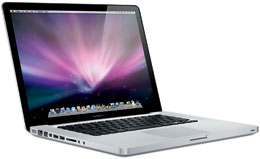 The MacBook Pro "Core i7" 2.66 15-Inch (Mid-2010) is powered by a 32 nm, dual-core 2.66 GHz Intel "Core i7" I7-620M (Arrandale) processor, with dedicated 256k level 2 cache for each core and a 4 MB shared level 3 cache. This system also supports "Turbo Boost" -- which "automatically boosts the processor speed based on workload" up to 3.33 GHz for this model -- and "Hyper Threading" -- which allows the system to recognize four "virtual cores" or "threads."
By default, it is configured with 4 GB of 1066 MHz DDR3 SDRAM (PC3-8500) installed in pairs (two 2 GB modules), a 500 GB Serial ATA (5400 RPM) hard drive, an 8X DL "SuperDrive", and dual graphics processors -- a NVIDIA GeForce GT 330M with 512 MB of dedicated GDDR3 memory and Intel HD Graphics with 256 MB of RAM shared with the system -- that Mac OS X automatically switches between for better graphics performance and better battery life, respectively, depending on application use.
The standard configuration of this model has an LED-backlit 15.4" widescreen TFT active-matrix "glossy" display (1440x900 native resolution), but it also is available via custom configuration with a "high-resolution glossy" 1680x1050 display and a "high-resolution antiglare" 1680x1050 display for an additional US$100 and US$150, respectively.
Connectivity includes AirPort Extreme (802.11a/b/g/n), Bluetooth 2.1+EDR, Gigabit Ethernet, a Firewire "800" port, two USB 2.0 ports, optical digital/analog audio in/out, a "Mini DisplayPort" that supports an external display at 2560x1600 (it also passes an audio signal), and an SD card slot. It lacks an ExpressCard/34 slot.
This model uses a "Unibody" aluminum case design -- milled from a single piece of aluminum -- and has a backlit keyboard, a new "no button" glass "inertial" multi-touch trackpad, and a non-swappable battery design that provides up to 8-9 hours of battery life.
Compared to its predecessor, this model has a very similar external enclosure, but an enhanced trackpad, and the same connectivity, except for the enhanced audio passing Mini DisplayPort. Internally, however, it has a substantially different architecture with a faster "Core i7" processor and faster graphics as well, although it shares the same memory. Battery life is improved too.
Also see:
- What are the differences between the "Mid-2010" 13-Inch, 15-Inch, and 17-Inch MacBook Pro models?
- What are the differences between the "Mid-2010" 13-Inch, 15-Inch, and 17-Inch MacBook Pro models and the "Mid-2009" MacBook Pro models that they replaced?
Buy Newer Macs at site sponsor OWC. Click for current options.
Sell Newer Macs at A+ BBB rated site sponsor Cash For Your Mac. Quick quote!
Upgrade This Mac at site sponsor OWC. Memory, storage & more.
- Tech Specs
- Ports
- Global Original Prices
- Popular Q&As
Click on a category for related details. The most commonly needed info is "open" by default, but all info is important. Asterisks (*) reference data in details fields.
| Introduction Date: |
April 13, 2010 |
Discontinued Date: |
February 24, 2011 |
| Details: |
The "Introduction Date" refers to the date a model was introduced via press release. The "Discontinued Date" refers to the date a model either was replaced by a subsequent system or production otherwise ended.
Also see: All Macs introduced in 2010. |
| Processors: |
1 (2 Cores) |
Architecture: |
64-Bit |
| Geekbench 2 (32): |
5566 |
Geekbench 2 (64): |
6277 |
| Details: |
Geekbench 2 benchmarks are in 32-bit and 64-bit modes, respectively. These numbers reflect an independently calculated average of user provided 32-bit and 64-bit results as submitted to the Geekbench website. Higher numbers are better.
You also might be interested in reviewing all 32-bit and 64-bit Geekbench 2 user submissions for Macs with the MacBookPro6,2 Model Identifier, which may include multiple models.
To dynamically compare Geekbench 2 results from different Macs side-by-side, see EveryMac.com's Ultimate Mac Comparison. |
| Geekbench 3 (32): |
2075 |
Geekbench 3 (32): |
4095 |
| Details: |
These Geekbench 3 benchmarks are in 32-bit mode and are for a single processor core and all processor cores, respectively. Both numbers reflect an independently calculated average of user provided results as submitted to the Geekbench website. Higher numbers are better.
You also might be interested in reviewing all 32-bit single core and multicore Geekbench 3 user submissions for Macs with the MacBookPro6,2 Model Identifier, which may include multiple models.
To dynamically compare 32-bit Geekbench 3 results from different Macs side-by-side, see EveryMac.com's Ultimate Mac Comparison. |
| Geekbench 3 (64): |
2196 |
Geekbench 3 (64): |
4461 |
| Details: |
These Geekbench 3 benchmarks are in 64-bit mode and are for a single processor core and all processor cores, respectively. Both numbers reflect an independently calculated average of user provided results as submitted to the Geekbench website. Higher numbers are better.
You also might be interested in reviewing all 64-bit single core and multicore Geekbench 3 user submissions for Macs with the MacBookPro6,2 Model Identifier, which may include multiple models.
To dynamically compare 64-bit Geekbench 3 results from different Macs side-by-side, see EveryMac.com's Ultimate Mac Comparison. |
| Geekbench 4 (SC): |
2235 |
Geekbench 4 (MC): |
4371 |
| Details: |
These Geekbench 4 benchmarks are are for a single processor core and all processor cores, respectively. All Geekbench 4 benchmarks are 64-bit. Both numbers reflect an independently calculated average of user provided results as submitted to the Geekbench website. Higher numbers are better.
You also might be interested in reviewing all single core and multicore Geekbench 4 user submissions for Macs with the MacBookPro6,2 Model Identifier, which may include multiple models.
To dynamically compare Geekbench 4 results from different Macs side-by-side, see EveryMac.com's Ultimate Mac Comparison. |
| Geekbench 5 (SC): |
471 |
Geekbench 5 (MC): |
992 |
| Details: |
These Geekbench 5 benchmarks are are for a single processor core and all processor cores, respectively. All Geekbench 5 benchmarks for the Mac are 64-bit. Both numbers reflect an independently calculated average of user provided results as submitted to the Geekbench website. Higher numbers are better.
You also might be interested in reviewing all single core and multicore Geekbench 5 user submissions for Macs with the MacBookPro6,2 Model Identifier, which may include multiple models.
To dynamically compare Geekbench 5 results from different Macs side-by-side, see EveryMac.com's Ultimate Mac Comparison. |
| Geekbench 6 (SC): |
439 |
Geekbench 6 (MC): |
858 |
| Details: |
These Geekbench 6 benchmarks are are for a single CPU core and all CPU cores, respectively. Both numbers reflect an independently calculated average of user provided results as submitted to the Geekbench website. Higher numbers are better.
You also might be interested in reviewing all single core and multicore Geekbench 6 user submissions for devices with the MacBookPro6,2 Model Identifier, which may include multiple models.
To dynamically compare Geekbench 6 results from different Macs side-by-side, see EveryMac.com's Ultimate Mac Comparison. |
| Processor Speed: |
2.66 GHz |
Processor Type: |
Core i7 (I7-620M) |
| Details: |
This model is powered by a 32 nm, 64-bit Intel Mobile Core i7 "Arrandale" (I7-620M) processor which includes two independent processor "cores" on a single silicon chip. Each core has a dedicated 256k level 2 cache, shares 4 MB of level 3 cache, and has an integrated memory controller (dual channel).
This system also supports "Turbo Boost" -- which "automatically boosts the processor speed based on workload" up to 3.33 GHz for this model -- and "Hyper Threading" -- which allows the system to recognize four total "cores" or "threads" (two real and two virtual).
Also see: How fast are the "Mid-2010" 13-Inch, 15-Inch, and 17-Inch MacBook Pro models compared to one another? How fast are they compared to the models each replaced? |
| Turbo Boost: |
3.33 GHz |
Custom Speeds: |
2.8 GHz* |
| Details: |
*Starting October 20, 2010, this model additionally could be custom configured with a 2.8 GHz Core i7 (I7-640M) for an additional US$200. This custom processor supports "Turbo Boost" up to 3.46 GHz as well as "Hyper Threading" with four virtual cores or "threads."
As requested by readers, EveryMac.com also has documented this custom configuration as its own model. |
| Processor Upgrade: |
Soldered |
FPU: |
Integrated |
| Details: |
Also see: Can you upgrade the processor in the "Unibody" MacBook Pro? |
| System Bus Speed: |
2.5 GT/s* |
Cache Bus Speed: |
2.66 GHz (Built-in) |
| Details: |
*This system has a "Direct Media Interface" (DMI) that "connects between the processor and chipset" in lieu of a traditional system bus. Intel reports that it runs at 2.5 GT/s. |
| ROM/Firmware Type: |
EFI |
EFI Architecture: |
64-Bit |
| L1 Cache: |
32k/32k x2 |
L2/L3 Cache: |
256k x 2, 4 MB |
| Details: |
Each core has its own dedicated 256k level 2 cache and the system has 4 MB of shared level 3 cache. |
| RAM Type: |
PC3-8500 DDR3 |
Min. RAM Speed: |
1066 MHz |
| Details: |
Supports 1066 MHz PC3-8500 DDR3 SDRAM.
Also see: How do you upgrade the RAM in the "Mid-2010" 13-Inch, 15-Inch, and 17-Inch MacBook Pro Core 2 Duo models? How much RAM of what type do they support? |
| Standard RAM: |
4 GB |
Maximum RAM: |
8 GB |
| Motherboard RAM: |
None |
RAM Slots: |
2 |
| Video Card: |
GeForce GT 330M* |
VRAM Type: |
GDDR3 |
| Details: |
*This system has dual graphics processors -- a NVIDIA GeForce GT 330M with 512 MB of dedicated GDDR3 SDRAM and Intel HD Graphics with 256 MB of DDR3 SDRAM shared with main memory. The system automatically switches between graphics systems based on use (when applications use OpenGL, Core Graphics or other graphically demanding technologies, the system will use the dedicated graphics card, otherwise it will use Intel HD Graphics to conserve battery life).
Also see: What type of video processor is provided by the "Unibody" MacBook Pro models? Is it upgradable? Which models have "dedicated" and "integrated" video memory? |
| Standard VRAM: |
512 MB* |
Maximum VRAM: |
512 MB* |
| Details: |
The NVIDIA GeForce GT 330M has 512 MB of dedicated memory. The Intel HD Graphics use 256 MB of memory, but this is shared with system memory. Apple also reports that when using Intel HD Graphics, the "memory available to Mac OS X may vary depending on graphics needs. Minimum graphics memory usage is 256 MB". |
| Built-in Display: |
15.4" Widescreen |
Native Resolution: |
1440x900 |
| Details: |
By default, this model has a 15.4" color widescreen LED-backlit TFT active-matrix "glossy" display with a 1440 by 900 native resolution. However, it also was available via custom configuration with a "high-resolution glossy" 1680x1050 display and a "high-resolution antiglare" 1680x1050 display (MC666LL/A) for an additional US$100 and US$150, respectively.
In addition to the native resolution, Apple reports that this system also supports "1280 by 800, 1152 by 720, 1024 by 640, and 800 by 500 pixels at 16:10 aspect ratio; 1024 by 768, 800 by 600, and 640 by 480 pixels at 4:3 aspect ratio; 1024 by 768, 800 by 600, and 640 by 480 pixels at 4:3 aspect ratio stretched; 720 by 480 pixels at 3:2 aspect ratio; 720 by 480 pixels at 3:2 aspect ratio stretched."
In Germany, site sponsor Sadaghian offers display replacement, graphics repair, logic board repair, battery replacement, data recovery, and other repair services for this MacBook Pro; free error analysis, free DHL shipping throughout Germany, and a 12-month warranty are included on all repairs.
In Spain, site sponsor iRepairs provides affordable repair and data recovery services. In-person and by mail repair services include the display, battery, keyboard, motherboard, and more for this MacBook Pro.
In Hong Kong, site sponsor iCertified provides well-reviewed repair services for the display, logic board, battery, water damage, and more, all with a 180-day warranty; free diagnostics and estimates; and optional pickup and delivery for this MacBook Pro. |
| 2nd Display Support: |
Dual/Mirroring |
2nd Max. Resolution: |
2560x1600 |
| Details: |
The maximum resolution supported on an external display is 2560x1600.
Also see: Are there any adapters or "hacks" that make it possible to connect a second external display to a MacBook, MacBook Pro, or MacBook Air model? |
| Standard Storage: |
500 GB HDD |
Std. Storage Speed: |
5400 RPM |
| Details: |
By custom configuration, this model could be equipped with a 500 GB Serial ATA hard drive running at 7200 RPM for an additional US$50. It also could be configured with a 128 GB, 256 GB, or 512 GB SSD for an additional US$200, US$650, or US$1300, respectively.
Also see: How do you upgrade the hard drive in the "Mid-2010" 13-Inch, 15-Inch, and 17-Inch MacBook Pro models? What type of hard drive do these models support? Can one replace the hard drive with an SSD?
In the US (and many other countries), site sponsor Other World Computing sells storage upgrades for this MacBook Pro.
Also see: SSD Compatibility Guide for All G3 & Later Macs. |
| Storage Dimensions: |
2.5" (9.5 mm) |
Storage Interface: |
Serial ATA (3 Gb/s) |
| Details: |
This model supports a single SATA II (3 Gb/s) 2.5" hard drive or SSD that is up to 9.5 mm thick. |
| Standard Optical: |
8X DL "SuperDrive" |
Standard Disk: |
None |
| Details: |
Apple reports that this slot-loading "SuperDrive" (DVD±R DL/DVD±RW/CD-RW) has a maxium write speed of "8x DVD-R, DVD+R; 4x DVD-R DL (double layer), DVD+R DL (double layer), DVD-RW, DVD+RW; 24x CD-R; 10x CD-RW" and a maximum read speed of "8x DVD-R, DVD+R, DVD-ROM; 6x DVD-ROM (double layer DVD-9), DVD-R DL (double layer), DVD+R DL (double layer), DVD-RW, and DVD+RW; 24x CD".
Site sponsor Other World Computing offers a "Data Doubler" mounting kit that may be of interest. It makes it simple to install a second hard drive or SSD in the optical drive bay of this MacBook Pro. |
| Standard Modem: |
None |
Standard Ethernet: |
10/100/1000Base-T |
| Standard AirPort: |
802.11a/b/g/n |
Standard Bluetooth: |
2.1+EDR |
| Details: |
AirPort Extreme (802.11a/b/g/n) and Bluetooth 2.1+EDR standard.
Also see: What is 802.11n? How is it different from 802.11b, 802.11g, and 802.11a? |
| USB Ports: |
2 (2.0) |
Firewire Ports: |
1 (800) |
| Details: |
Two 480-Mbps USB 2.0 ports, one 800-Mbps Firewire "800" port. |
| Expansion Slots: |
SD Card Slot |
Expansion Bays: |
None |
| Details: |
This model has an SD card slot. No expansion bays are provided.
In the US (and many other countries), site sponsor Other World Computing sells a wide variety of external expansion options and accessories, including docks, adapters, cables, input devices, cases, and more for this MacBook Pro.
Also see: Are SD Card slot storage expansion options available for the "Unibody" MacBook Pro models? Which are compatible? Is this type of storage a good idea for these models? |
| Incl. Keyboard: |
Full-size |
Incl. Input: |
Trackpad (Inertial) |
| Details: |
Apple reports that the backlit integrated keyboard has "78 (US) or 79 (ISO) keys, including 12 function keys, 4 arrow keys (inverted "T" arrangement)."
The glass multi-touch trackpad supports "inertial scrolling, pinch, rotate, swipe, three-finger swipe, four-finger swipe, tap, double-tap, and drag capabilities". |
| Case Type: |
Notebook |
Form Factor: |
MacBook Pro (Unibody) |
| Details: |
By default, this MacBook Pro uses a black and silver "unibody" case design milled from a single piece of aluminum with a "catchless" magnetic latch. However, if configured with an "anti-glare" (matte) display, it has a silver border framing the display rather than a black border. |
| Apple Order No: |
MC373LL/A* |
Apple Subfamily: |
Mid-2010 15" |
| Details: |
*MC373LL/A refers to the standard configuration of this model with a 1440x900 "glossy" display. With a "high-resolution" 1680x1050 matte finish "anti-glare" screen, it was assigned order number MC666LL/A. |
| Apple Model No: |
A1286 (EMC 2353*) |
Model ID: |
MacBookPro6,2 |
| Details: |
*Please note that these identifiers refer to more than one model. In this case, please also note that the EMC number is not externally listed on the notebook so it cannot be used readily for identification.
Also see: All Macs with the A1286 Model Number, the 2353* EMC Number, and the MacBookPro6,2 Model Identifier.
For more about these identifiers and how to locate them on each Mac, please refer to EveryMac.com's Mac Identification section. |
| Battery Type: |
77.5 W h Li-Poly |
Battery Life: |
8-9 Hours |
| Details: |
Apple reports that this model has a "77.5-watt-hour lithium-polymer battery" that provides "up to 8-9 hours of wireless productivity".".
Also see: What is the "real-world" battery life of the "Mid-2010" 13-Inch, 15-Inch, and 17-Inch MacBook Pro models? How does the battery life of each compare to the model each replaced?
In the US (and many other countries), site sponsor Other World Computing sells quality batteries for this MacBook Pro. |
| Pre-Installed MacOS: |
X 10.6.3 (10D2094) |
Maximum MacOS: |
X 10.13.x* |
| Details: |
*This system fully supports the last version of OS X 10.8 "Mountain Lion" as well as OS X 10.9 "Mavericks" except for "Power Nap" and "AirPlay Mirroring" (which also requires an Apple TV 2nd Gen or higher). It also supports the last version of OS X 10.10 "Yosemite" and OS X 10.11 "El Capitan" -- including Mac-to-Mac AirDrop capability -- but no other advanced features are supported. It is capable of running macOS Sierra (10.12) as well, although it does not support the Universal Clipboard, Auto Unlock, or Apple Pay features. Finally, this model is capable of running macOS High Sierra (10.13), and it supports HEVC (High-Efficiency Video Coding), but it does not support hardware accelerated HEVC. It is not compatible with macOS Mojave (10.14) or later versions of the operating system.
Additionally, please note that OS X "Lion" 10.7 and subsequent versions of OS X are not capable of running Mac OS X apps originally written for the PowerPC processor as these operating systems do not support the "Rosetta" environment. To run PowerPC applications on this Mac, it will be necessary to use Mac OS X 10.6 "Snow Leopard".
Also see: Which Macs are compatible with macOS High Sierra (10.13)? What are the system requirements? Which Macs support HEVC? |
| Minimum Windows: |
XP SP2 (32-Bit)* |
Maximum Windows: |
8.1 (64-Bit)* |
| Details: |
*Apple's Boot Camp 4 formally supports the 32-bit version of Windows XP SP2 as well as the 32-bit and 64-bit versions of Windows Vista and the 32-bit version of Windows 7. Boot Camp 5 supports the 64-bit versions of Windows 7 and Windows 8.
Although Apple does not support Windows 10 via Boot Camp 5 (officially or otherwise), this system meets Microsoft's hardware requirements and it very well may be possible to boot Windows 10 on this Mac. If you have installed Windows 10 on this system (successfully or unsuccessfully), please share the results of your experiment. Thank you. |
| MacOS 9 Support: |
None |
Windows Support: |
Boot/Virtualization |
| Details: |
Also see: Are there any third-party programs to run Mac OS 9/Classic applications on Intel Macs?
For more on running Windows on Intel Macs, please refer to the exhaustive Windows on Mac Q&A. |
| Dimensions: |
0.95 x 14.35 x 9.82 |
Avg. Weight: |
5.6 lbs (2.54 kg) |
| Details: |
In inches while closed - height by width by depth, (2.41 cm, 36.4 cm, 24.9 cm). |
| Original Price (US): |
US$2199* |
Est. Current Retail: |
US$200-US$250 |
| Details: |
*This is for the stock configuration with a 2.66 GHz processor. Starting October 20, 2010, this model also could be custom configured with a 2.8 GHz Core i7 (I7-640M) for an additional US$200.
Photo Credit: Apple Computer. |
Global original prices for the MacBook Pro "Core i7" 2.66 15" Mid-2010 in 34 different countries and territories follow; organized alphabetically by region.
For global original prices for Intel Macs in one particular country on a single page, please refer to EveryMac.com's Global Original Prices section.
Original Prices - North & South America
| Canada: |
C$2249 |
Brazil: |
R$8.199 |
| Mexico: |
MXN $32,999 |
United States: |
US$2199* |
Original Prices - Europe
| Austria: |
€2149 |
Belgium: |
€2199 |
| Denmark: |
DKK 16,499 |
Finland: |
€2199 |
| France: |
€2149 |
Germany: |
€2149 |
| Ireland: |
€2199 |
Italy: |
€2149 |
| Luxembourg: |
€2089,96 |
Netherlands: |
€2149 |
| Norway: |
NOK 17.990 |
Portugal: |
€2149 |
| Spain: |
€2099 |
Sweden: |
SEK 20.495 |
| Switzerland: |
CHF 2'799 |
United Kingdom: |
£1799 |
Original Prices - Asia
| China: |
RMB 16,988 |
Hong Kong: |
HK$16,788 |
| India: |
Rs 129,900 |
Indonesia: |
Rp 21,999,000 |
| Japan: |
¥208,800 |
Korea: |
KRW 2,790,000 |
| Malaysia: |
RM 7,199 |
The Philippines: |
PHP 112,990 |
| Singapore: |
S$3,188 |
Taiwan: |
NT$75,900 |
| Thailand: |
THB 75,900 |
Vietnam: |
VND 48,999,000 |
Original Prices - Australia & New Zealand
| Australia: |
A$2798 |
New Zealand: |
NZ$3799 |
If you have additional original prices for this model, please get in touch. Thank you.
Ten of the most popular Q&As about the MacBook Pro models follow.
Permalink | Report an Error/Typo | Sign Up for Site Update Notices
<< MacBook Pro (Home) | Also see: MacBook Pro FAQ
Established in 1996, EveryMac.com has been created by experts with decades of experience with Apple hardware. EveryMac.com includes, and always has included, original research incorporating detailed, hands-on inspection of packaging, computers, and devices as well as extensive real-world use. All information is provided in good faith, but no website or person is perfect.
Accordingly, EveryMac.com is provided "as is" without warranty of any kind whatsoever.
EveryMac.com, and the authors thereof, shall not be held responsible or liable, under any circumstances, for any
damages resulting from the use or inability to use the information within. For complete disclaimer and copyright
information please read and understand the Terms
of Use and the Privacy Policy before
using EveryMac.com. Copying, scraping, or use of any content without expressed permission is not allowed, although links to any page are welcomed and appreciated.




 1* (Mini DisplayPort w/ Audio)
  None
None  None
None  None
None  None
None None
None 2 (2.0)
 1 (800)
 1 (RJ-45)
 None
None None
None 1 (Internal)
 1
1 1
1 1
1 1
1 None
None N/A
N/A 1
1